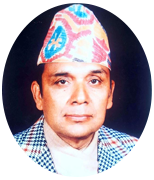
Recalling Hajur Buwa
Animesh Pant
Finance Analyst,
University of California,
San Francisco
I have a lot of memories about Hajur Buwa. When I was in my childhood days, I used to visit his room at five in the morning to eat sugar cubes while he was drinking his morning tea. After that, I would typically follow him upstairs to the worship room and imitate him while he would meditate, and throw offerings in the fire while he was performing yagya. He was always on the move-from travelling in the city to business or socially-related engagements or abroad for various international events orchestrated by foreign organizations. In spite of his myriad of activities, however, one trait which I will always identify surrounding his life was that he devotedly made family time his top priority. All individual members of the family would eat lunch collectively. Hajur Buwa was the cynosure at these events. Frequently, he would also take all of us out to restaurants.
From what I know about him, he was a rebel when he was young and argued with his father to pursue higher education. Things would have been different for our family if he had not culled to do so. He fostered the importance of education in our family and motivated his children to pursue higher education, even if it meant going abroad, a quality which has permeated through our family. Hajur Buwa spent his entire career as a bureaucrat, research scholar, a politician and a diplomat who travelled to many parts of the world. He also lived in Japan for a number of years with his family. Thus, travelling beyond Nepal’s borders and being exposed to new cultures has made our family very open and liberal.
Above all, Hajur Buwa had a soft corner for his grandchildren. Even though he had a stern look on his face, we weren’t scared of him. There were times when he took the younger flock out exclusively. The last time I was in Nepal in 2005, he took us to the Chimney Restaurant, Hotel Yak and Yeti. It was the first and the last time that all of us had a drink together-something that I will always relish. That moment made me realize how fast time had passed, how my siblings and I had grown up and how active Hajur Buwa still was.
Hajur Buwa has been an inspiration to our family and equally significant to the country. He has created a standard of personal achievement that has not been surpassed by a lot of people. Yet, recalling this quality has driven us in the family to not only reach our personal career and educational goals, but to exploit our true potential.
Reminiscing About Yadav Mama
Dr. Ashok Banskota
Senior Medical Doctor
“Yadav Mama” as he was fondly known amongst us brings back memories of him as a patient when he used to consult me for his chronic musculoskeletal ailments. Consultations would be frequently timed to his pre-departure schedules of travel abroad for meetings and conferences. There was an air of urgent anticipation for even the simplest of advice and counseling that was provided.
I remember him to be always with a smile and very gentle mannerisms. He would enter the consultation room greeting me with folded hands and making apologies for the “intrusion.” His gentle stooped posture was a hallmark of his overall elegant posture. I remember him to have very soft hands when I examined them, reflecting a softer and loving soul within. He was always impeccably dressed with national attire.
Mama’s cervical spondylitis was of a long standing nature and used to act up sporadically. He would be more concerned when travel was around the corner. He was well versed in the management of his symptoms that he had been living with for so long. Use of a cervical collar, initiating some traction treatment was well-known to him. My role was generally to make sure there were no complications and to reassure him. I think he learned to live with the ailment remarkably well.
Mama was frequently approached by people for help and on some occasions I remember him referring patients to me for surgical care. The patients were village folk from his constituency and he would take responsibility for the entire treatment. Very quietly, he extended a helping hand to many people, no doubt!
In a lifetime packed with activities, challenges and many successes, Yadav Mama lived it fully to the satisfaction of all. He will be remembered for this life-long contributions to the society, but will continue to be sorely missed for the gentle, quite Mama that I remember him as.
As I Found Him
Dr. Badri Raj Pandey
Former Senior Officer,
World Health Organization
A man of high ethical values, affable personality filled with humility, that is how I evaluate Dr. Yadav Prasad Pant. I was inspired by his simplicity, regular habits of reading and teaching and his concern for issues of national importance since my early days. I was a sort of his personal physician and he would closely consult me even on the simplest medical problem as he suffered from peptic ulcer when he was young. He used to have gastric upsets and vomited blood. As a consequence, he had to remain under rigid medical regime for quite some time. I remember advising him not to be stressed too much and practice relaxation methods, as this condition had a lot to do with mental stress affecting those striving to become a perfectionist. Even after I gave up active clinical practice in favour of full time work in public health (Family Planning and Maternal and Child Health) during 1970s, he used to consult me for health problems.
He was a voracious reader and perused lay books and magazines related to health matters, besides those related to his own discipline. He would discuss with me what he had read. This would spur me to consult medical books to answer his questions on physical and mental health. I would repeatedly reiterate that promoting healthy life style with minimal use of drugs would result in good health and nobody could be one hundred percent perfect and that his health was in excellent form. Under advice from medical colleagues, he was motivated to take drugs though mild ones for anxiety, pain, among others. However, I would discourage him from taking medicines unless absolutely necessary. Instead, I would do a lot of counseling and this would pay off when I found him relaxed and cheerful.
Three years ago, he called me and expressed his desire to go for pilgrimage to Badrinath and Kedarnath provided that I accompany him. I felt it was a good opportunity to visit those sacred places which I would perhaps not visit on my own. At Badrinath, he was running fever and I advised him to take bed rest. What I found later was that he had quietly called the porter and went to the temple on his back, had darshan of the deity and took a full round of the premises. I reprimanded him stating that he should not have done it while still having fever. He just laughed. I realized that here was a man with potent determination.
He was a man of letters and a great writer. He published numerous books and articles on economics. I do not know what pushed him to politics, but he realized later that Nepalese politics was not a place for him, for a person who is honest and incorruptible. He was at times unhappy that he was being utilized by others for their benefit and confided to me that he sometimes felt like a peg in a square hole. He was fed up with corruption, greed and betrayal by politicians for their self interest and gave up politics. I remember him telling time and again “I wish I could do more for the country”. I would reassure him that he had done a lot for the country with impeccable honesty, integrity, commitment and hard work and that we all felt proud of his achievement.
The All-Rounder
Chandrika Prasad Yadav
Member, Constituent Assembly
Dr.Yadav Prasad Pant, the name of this great personality, came into my sight and mind when I saw his signature on rupees’ note. I had profound feeling for his first name ‘Yadav’ because my last name is ‘Yadav’. Pronouncing the name, I used to be proud and glorious. I used to inquire to my seniors and elders about this senior personality. My father and father-in-law mentioned that he was a landlord (Zamindar) and the Governor of Nepal Rastra Bank (NRB). Later on, I heard his name broadcasted on Radio Nepal as Finance Minister, Water Resources Minister, among others.
When I came to Kathmandu for higher education, I listened to him delivering speeches on many occasions. My friends conveyed to me that before entering active politics, he had served the nation as Finance Secretary, Governor of NRB, and Nepalese Ambassador to Japan, respectively.
Once, I had an opportunity to meet Dr. Pant along with my friend, Kailash Thakur of Thulo Khairatawa, Nawalaparasi. I found him to be very gentle and simple. We were holding talks about different topics concerning his life, education and political career.
In short, I remember Dr. Yadav Prasad Pant as
a versatile and experienced bureaucrat;
a highly successful and respected governor of NRB;
a veteran diplomat and politician;
a dedicated social worker;
a peace-loving and follower of humanity.
Contributions to United Nations Association of Nepal
Dambar Bir Thapa
President,
United Nations Association of Nepal
Profile of Dr. Yadav Prasad Pant
Dr. Yadav Pant had grown up in Banaras, India where he obtained a Master’s Degree in Economics from Banaras Hindu University (BHU) in 1948 and was the first Nepali scholar to do Ph.D in 1952. His name and fame as a leading economist and the emerging intellectual of Nepal had become far and wide both within and outside Nepal. He started not only occupying a frontal position in a galaxy of prominent Nepalese economists and professionals but also receiving a number of job offers of high ranking position, both nationally and internationally.
Dr. Y.P. Pant had embarked upon an international journey through joining United Nations Economic Commission for East (ECAFE, now ESCAP) starting from 1957-1959. He was the first Nepalese to work in the United Nations System. He served the International Bank for Reconstruction and Development (IBRD) as Alternate Governor from Nepal from 1962 to 1967. He was Governor both at the International Monetary Fund (IMF) from 1968 to 1973 and at IBRD from 1980 to 1983. The prestigious positions which he held at these two international institutes had contributed to enhancing the international image of Nepal and promoted the exposure of his rising personality as a prominent economist. His excellent performance at these two multilateral institutes had helped him win the confidence of the international community and earned him a great reputation which spread far and wide. The ability, prominence and expertise which Dr. Pant had shown to the international community while working in these international banks and ESCAP had opened the door for many Nepalese also deeply interested in joining banks of global nature and other international organizations. The ability, prominence and expertise which Dr. Pant had shown to the international community while working in these international banks and ESCAP had opened the door for many Nepalese who were also deeply interested in joining banks of global nature and other Asia and the Far international organizations.
Dr. Y.P. Pant was a great social worker and a committed peace activist. His association with a number of nongovernmental enterprises bears witness to the fact that he had keen interest in rendering service to the society. His association with a number of academic, social, economic and professional organizations demonstrates his wide interest and vision.
As adumbrated earlier, Dr. Y.P. Pant served UN by joining ESCAP and participated in the UN conferences, time and again. He also rendered services to the UN through United Nations Association of Nepal (UNA/N) which reflected his unswerving commitment to the ideals of UN.
World Federation of United Nations Associations (WFUNA) and Dr. Pant’s Contributions
Dr. Pant was the first Nepali to become the Vice President of WFUNA and served it from 1990 to 1997 and as its Executive Member from 1997 to 2005. He actively participated in many Plenary Assemblies of WFUNA and Asia Pacific Regional Conference representing UNA/N. He attended as the head of Nepal’s delegation to the Thirty-Third Plenary Assembly of WFUNA held in Barcelona, Spain in November 1991. He represented Nepal as the head of delegation at the Thirty- Fourth Plenary Assembly held in Geneva, Switzerland in 1993. Again, he participated in the Thirty-Fifth Plenary Assembly which was held in 1995 in San Francisco, USA. His participation at many WFUNA Plenary Assemblies raised the image of the UNA/N and introduced it to other UNAS of the world. His participation in Regional Conferences at Dhaka and Calcutta were milestones added to the ongoing march of UNA/N.
The Role of Dr. Pant in UNA/N.
Established in 1956 under the Chairmanship of Prof. Yadu Nath Khanal, one of the most learned expert in foreign affairs, the UNA/N emerged as an intellectual forum consisting of diplomats, high ranking government officials, professors and reputed social workers. Dr. Yadav Prasad Pant was the founding Vice-President of UNA/N who, from the beginning, played a pioneering role in the promotion and development of this Association. One of the primary objectives of the founding of UNA/N was to promote, strengthen and disseminate the ideals, goals and purposes embodied in the charter of UN.
As an energetic, dedicated and leading pioneer, Dr. Pant played a key role in shaping and restructuring UNA/N during the period of fifties and sixties and provided a boost to all the activities of the Association designed to strengthen and disseminate ideals and goals of UN. The whole and sole responsibility of running UNA/N fell on Dr. Pant who took a number of initiatives to revamp and revitalize it.
There were a number of firsts that happened during the time of Dr. Pant, which are delineated below.
First, a book entitled “Nepal and the United Nations” which was published for the first time in the history of UNA/N was one of the major “first” that occurred during the time of Dr. Pant.
Second, the tradition of inviting the Prime Minister of Nepal to the UN Day programme, organized by UNA/N every year was another “first” that took place during Dr. Pant’s tenure.
The third “first” of the time of Dr. Pant is the legal registration of UNA/N at the office of Kathmandu District Administration.
Active participation by the representatives of UNA/N both in Asia Pacific regional conferences and World Plenary Assembly of WFUNA was the fourth “first” through which UNA/N received international exposure.
The fifth “first” which is a marked feature of the presidency of Dr. Pant was the financial support that the Government of Nepal started providing to UNA/N on a regular basis.
All these ‘firsts’ are important milestones that enhanced the effectiveness of the role of UNA/N. Holding programme on themes of national and international importance almost on a regular basis was another vital feature of his presidency. It was under his leadership that UNA/N could secure a solid foundation and gain wide popularity and recognition among the intelligentsia of the country. UNA/N made a firm footing in the mind of Nepalese people and intellectuals as a NGO of supreme importance, particularly in relation to the issues of UN. In short, it can be said that UNA/N enjoyed its heyday during the leadership of Dr. Pant. Almost all the infrastructures essentially needed to promote the strengthening of UNA/N were built during his tenure.
Conclusion
In view of the contributions which Dr. Pant had rendered to promote the strengthening of UNA/N through organizing a number of vitally important programmes and the role he had played in mobilizing public opinion and awareness in support of UN under the auspices of UNA/N, he aptly deserves to be regarded as the father and mother of UNA/N. It was nourished and nurtured under the dynamic leadership and care of Dr. Pant. It is with Dr. Pant as President that it could grow into maturity and take strides forward towards its final destination.
It was under the sagacious, enlightened and dynamic leadership of Dr. Pant that UNA/N was deeply committed to highlight the policy of Nepal’s Government towards UN. “Simple living, high thinking” is an ideal which was the basis of Dr. Pant’s social life and popularity. Endowed with qualities of soft spokenness, religiousness, out-spokenness, kind heartedness, considerateness, and humanness, Dr. Pant always adhered to the principles of truth, justice and humanity.
The writer of this piece opines that there might be very few UNAS in the world to have an internationally well-known figure like Dr. Pant as their President. UNA/N had the honour and pleasure of having Dr. Pant as its president, a possessor of moral integrity, moral character and a heart filled with the milk of humanity and love for others. His noble ideas and ideals have always remained a source of inspiration and guidance for this writer and will continue to inspire and guide him throughout his life. It was a great pleasure and honour for this writer to have opportunities to accompany Dr. Y. P. Pant to Delhi, Calcutta, Beijing and Bangkok to attend the Asia Pacific regional conferences organized by WFUNA. These opportunities provided the writer ample time to closely study and understand Dr. Pant whose nature, behaviour and way of dealing has left a great impression on him.
It is this writer’s experience that while going abroad Dr. Pant would strictly observe the principle of “caring and sharing” and take care of his friends. Dr. Pant was a humanist, philanthropist, internationalist and federalist, both by faith and action. His noble ideas and ideals will continue to illuminate the path ahead towards building a strong, effective and active UNA/N with capacity and potentialities to contribute, to a large extent, to galvanizing Nepali people in support of UN. Keeping in view the monumental contributions that Dr. Pant had made in the promotion of the ideals and goals of UN and WFUNA, UNA/N has unanimously decided to present him UNA/N Peace Award posthumously and initiate “Dr. Y.P. Pant Memorial Lecture” programme. Dr. Y.P. Pant lives and will live in what UNA/N does and will do in the days to come. UNA/N will carry forward the torch lit by Dr. Pant illuminating its path towards a prosperous, dynamic and peaceful future. He was a man of great vision, an idealist who will remain a legendary figure in the history of WFUNA and UNA/N for many years to come.
Economic Contributions
Dila Ram Subedi
Assistant Director,
Nepal Rastra Bank
Y.P. Pant demonstrated multi-dimensional personality and dynamic thoughts in different sectors of the Nepalese economy as well as in the field of political and social activities. His practical experiences of using economic theories resolving the developmental issues of Nepal and the conceptual framework developed for the Nepalese economy are highly beneficial. Basically, he had been involved in devising various economic policies of the government in Nepal for several decades.
Dr. Pant was involved in research and creation of economic ideas during six decades. His economic thought developed from his involvement in different sectors during his life cycle. During his student life, Dr. Pant devoted himself to enhance the broader knowledge about the economy. He was motivated by the works of renowned economists such as J.M. Keynes, Karl Marx, Adam Smith, J. Schumpeter and P.Samuelson. He concentrated on welfare economics, planned concepts and also sectoral development and initiated some macroeconomic ideas to shape the economy of Nepal.
He devoted his life in the education sector directly with active contribution as a Professor in Tri-Chandra Campus, Kathmandu. He explained the economics of developing and developed countries. As a teacher, he authored numerous books in various subjects like agriculture, population, development, monetarism, macroeconomics etc. We know Dr. Pant as the seniormost economist of Nepal.
Dr. Pant was appointed Ambassador to Japan (Residential), Australia, New Zealand, Philippines, and Republic of Korea in 1974. He had an opportunity to gain knowledge on the successful stories of these economies. He applied some of his experiences in the Nepalese context. Dr. Pant was the precursor of economic diplomacy in Nepal. As an ambassador, Dr. Pant’s role in establishing foreign economic diplomacy is noteworthy. He also contributed ideas to establish a link between North-South countries through his ambitious book entitled “North-South Dialogue: Issues and Options.”
The economy of a nation becomes stable if the political environment is stable. This was one reason why Dr. Pant had some interest in politics. His ‘political economic concept’ was used for allocating resources to the poor, disabled and dependent people. Thus, his political career made him create the appropriate concept that was essential for the development of the nation.
Dr. Pant had been allured into the economic field by three factors, namely family background, social and cultural factors and political factor.
Though he was a landlord, he struggled in getting the right of farmers. His main emphasis was to free the people from economic chain and maintain social justice. To be precise, we can assume that his family background shaped his concepts and influenced him to serve the nation. His father was against educating his son and did not want him to hold any other job.
Dr. Pant recalls an event in his life when his Ph.D. thesis guide Dr. P.S. Lokanathan had approached him to join ECAFE in Bangkok. It took one full year to convince his father.
Though he had no interest in literature, his career was initiated from it. When he was a student in Banaras, he was active in youth movements and literary writings. He had published several articles in “Yugabani Weekly.” He was inspired by late Rudra Raj Pandey, one of the prominent educationalists of Nepal, who later became his father-in- law. Dr. Pant was also inspired by the novel “Rupamati” written by late Pandey.
He was involved in social services. He met different economists in India during his student life and he introduced different concepts to change the traditionally shaped economy of Nepal and other developing countries.
Initially, during his early life, Dr. Pant had no interest in politics. After he returned from Bangkok (where he was an employee in ECAFE), he was made the Economic Advisor by the Congress Government. His amicable relationship with Subarna Shumshere and B.P. Koirala facilitated in the development of his career in the field of economics.
Dr. Pant was a versatile economist. He made an immense contribution in different aspects of economics. His various books, articles, interviews and other practical contributions add to the treasures of our national economy. To eradicate poverty, create employment opportunities, stabilize the price and economy, his ideas are valuable and indispensable. Again, while Dr. Pant advocated the strong role of government, he also called for the private sector’s active participation for economic development.
Dr. Pant was a member of the National Planning Commission right after its inception. His primary focus was on poverty alleviation. As the Finance Secretary and then the Governor of the Nepal Rastra Bank, Dr. Pant made major reforms on the banking policies. He gave emphasis on expanding new branches of commercial banks in rural areas.
To sum up, the ideas of Dr. Pant should assist in formulating the policies for national development. The main aspect developed by Dr. Pant related to the concept of liberal economy. According to him, national production should be raised through market forces and with the active participation of the private sector. Dr. Pant was also instrumental in constructing sectoral development planning in Nepal. He is the guardian of our economic thought. He was responsible for the implementation of different policies in the monetary sector and played a pivotal role in the establishment of a single currency for Nepal. In the international flora, Dr. Pant always called for developed countries to transfer their technologies and other resources to the developing countries to enhance their conditions. Dr. Pant emphasized on expanding exports for reducing the trade deficit. As he was a liberal economist, he argued for foreign investment, foreign aid and technological transformation. He focused on the open, liberal and market oriented economy that created the economic order in emerging market economies.
Painful Recollections
Hitesh Pant
Student, American University,
Washington D.C.
The sullen faces of my family members echoed the entire story. The continual arrival of distant relatives and friends heightened the sorrow in the living room. As I quietly progressed into the already crammed space, I didn’t know what to do, whether to put my head down like the rest of the people or place a sad and dejected face in light of the disturbing news that had gathered us all together.
My beloved grandfather had passed away.
The news of his demise came as an enormous shock to everyone; from those who closely knew him, those who had met him once in a blue moon, or the people who had just seen him humbly and confidently meandering through Kalika Marg on his own, even at the age of 82.
The news didn’t sting me as such when I first heard it through the subdued voice of my mother. Condition critical; blood pressure high; biopsy tomorrow; severe lung infection; these were a handful of several messages that my father would text in now and then from Bangkok. As I was accustomed to reading these messages day after day after day, and likewise as the news spread from one family member to the other, I thought it was obvious that my grandfather was slowly slipping away from the world and that everyone should accept it and move on with their lives.
The following day I prepared to go the airport, along with my cousins, to pick up my grandfather’s body which would arrive in a coffin from Bangkok. I was calm and composed till the drive to the airport; I had no feeling of uneasiness whatsoever. But as I stepped out of the car, an air of anxiety enclosed upon me. I began to feel uncomfortable, queasy; something was not right. Something seemed missing, something seemed lost, and when I finally figured out what it was, at last I disappointingly took in the fact that I would never have the chance to see his face again.
His incessant urge to taste an assortment of foods which lead to humorous arguments with my grandmother; his persistence to go to shopping malls and buy goods himself even if he was having difficulties walking; his longing to dress up like a middle-aged man topped by applying various whitening creams and spraying on the most aromatic and fragrant deodorants; his desire to watch tons of Hindi films; his joking pleas towards me to get him a new and expensive pen; his requests to me to fix his DVD player and teach him how to use the remote control; most of all, his motto, which he never spoke of, but certainly lived side-by-side with – “Live life till the fullest”.
I would never perfect it like he did. Nor would I ever witness how to do it.
As the coffin arrived on the cargo hold, I was trying not to break down into snuffles and shed tears. But when I saw his photo adorned by garlands of marigold on the truck where the coffin would be transferred, when I locked my eyes with his, I couldn’t control the grief within me and exposed my emotions for all to see. I cried.
Our Doctor Saheb
Jagadish Upadhyay
Former Senior Official,
World Bank
My professional association with Dr. Y. P. Pant began in an adversarial manner. That was in the summer of 1966 when Dr. Pant suddenly took helm of the erstwhile Ministry of Economic Planning, in addition to the Ministry of Finance. That news came to me as a Tsunami just when I was most vigorously enthusiastic in my career.
I had returned a year earlier to the Ministry of Planning after graduate study in the US. I was hot-blooded, young, energetic and in a great hurry to contribute to Nepal’s economic development. My supervisors had also responded to my enthusiasm by appointing me an Acting Under Secretary and making me in charge of the Power and Industry Division. The news of Dr. Pant’s arrival came as a huge shock because I had heard the rumor that Dr. Pant would not be good with younger professionals like me and with new ways of doing things. How completely wrong were those rumors and my early impressions! Thank God I was able to spend over three years of my professional life with him and also discover him firsthand. Otherwise, I would have missed some of my best professional years as well as the association, the affection and the blessings of one of Nepal’s legends.
I remember Dr. Pant’s first staff meeting which was jointly attended by the Finance and Planning officials. The Finance Ministry was larger of the two so their staff had overwhelmed it. I had not enjoyed the company in that meeting, and my attitude towards the Pant administration was already negative. I ended up talking too much, probably negative and critical of what Dr. Pant had said. A few days later, I was summoned to his office. I went there prepared to get my pink slip and to say good bye. Dr. Pant gave me my first surprise. He came to the door of his large office to receive me with tremendous warmth and kindness. He started the conversation describing his plan to reorganize the Planning Ministry, including that he was creating an all-important new Division that would combine the planning and annual development budgeting functions covering all sectors. He asked me to head that Division and also to choose most other colleagues for that Division. I was completely at a loss. But I did not commit myself, until another supervisor whom I highly respected brought me to my senses after a few days. My subsequent three years under Dr. Pant turned out to be among the most satisfying and rewarding periods in my career inside and outside Nepal.
Like all successful leaders, Dr. Y.P. Pant believed in selecting his staff carefully and then in delegating maximum possible responsibilities. He was not eager to check details but he monitored major assignments and their critical steps restlessly. His staff enjoyed full trust and maximum support but, at the same time, he expected honesty, full responsibility over the assigned tasks and good results. This is also what I have always found with highly successful leaders.
I continued to maintain personal contacts with Dr. Pant long after ending professional contact when I left Kathmandu. He was always like an older brother to me. His whole family was as affectionate as my brothers’ families. I used to be surprised that Dr. Pant never discussed with me personal relation issues concerning other people we both knew.
I had so many opportunities to witness Dr. Pant conduct meetings with large number of officials of international and bilateral aid agencies when I worked with him, and even sometime afterwards when Dr. Pant used to visit Washington as the Governor of Nepal Rastra Bank or Finance Minister. He always tried to use the occasions for the best of Nepal. I used to be amazed to see his lack of interest to exploit the occasions for self-promotion which is not uncommon with many leaders.
Dr. Pant was a pioneer all his life, never fearful to tread on uncharted waters. Just like he was the first Nepali to obtain a Ph.D degree, he was also the founder or a founding member of so many national or internationally reputed associations and societies, be it like the Rotary Club, the Society for International Development, or numerous other cultural associations or intellectual bodies. But I always felt he used to be far busier than what might be appropriate for his health or age. Many years later I found that this was one addiction he could not live without.
Our affectionate Doctor Saheb will always remain in our hearts.
A Great Source of Inspiration
Dr. Kamal P. Upadhyaya
Professor, University of New Haven
Dr. Yadav Prasad Pant was a larger than a life figure for me ever since I was a small child. Growing up in a small village in Rupandehi District in Nepal, I used to hear a lot about him from my parents. They often referred to Dr. Pant as the most educated person in Nepal. In those days, I remember hearing that a double M.A. is the highest level of education. So I thought that as the most educated person in the country, he must have a double M.A. Of course, I did not know then what a M.A. or double M.A. was, let alone a Ph.D. Since we did not have any college graduates in our family, Dr. Pant became my idol. I too desired to become an educated person. I wanted to have a double M.A. degree.
When I was ten years old, I joined my uncle and older brother in Kathmandu for schooling. My uncle was preparing for his B.A. exams and my brother was attending Padmodaya High School. We did not have any relatives or family friends in Kathmandu at that time other than Dr. Pant’s family with whom our family had a long-time association. At the same time, I was too young to understand a lot of things but later I discovered that we were told by our parents to seek help from Dr. Pant in case we needed anything. Later, following my brother, I also joined Padmodaya High School. It was a little hard for me to adjust to the new environment and I used to be homesick. Our parents used to send us living expenses (a bank draft) every month via the postal service. In those days, the only mode of transportation from Bhairahawa (Siddarthnagar) to Kathmandu was by airplane. During the rainy season, flights were often cancelled, sometimes for weeks. This meant that we did not receive our monthly living allowances from home on time. Under such circumstances, we used to visit Dr. Pant’s house in Kalikasthan for money, which my father would reimburse later. On one such occasion, I had an opportunity to meet Dr. Pant for the first time in my life. He was very affectionate and asked me if I was feeling homesick. He elucidated to me that such sacrifices were a part of life which many have to go through for a good education. He told us that he too went through such experiences as a student. He advised us to not worry too much. If we had any problems, he was always available for help. My first meeting with him boosted my confidence and helped me adjust better to my new environment in Kathmandu, away from home.
Eventually, I completed high school and started my college education. I became fascinated with economics even before I understood what economics was all about. Dr. Yadav Prasad Pant was probably the main reason for this fascination. When I was completing high school, I knew that Dr. Pant was the Secretary of Finance. At one point in time, he was the Governor of Nepal Rastra Bank and I remember seeing his signature on the currency. Since Dr. Pant was an economist and he held very responsible positions in government, I used to think that economics was an important and useful area of study. So, I decided to pursue my study in economics. In college, the one course I took in economics was the Nepalese Economy. One of the required readings for this course was “Economic Development in Nepal” written by Dr. Y. P. Pant. This book was the first ever published material that evaluated Nepal’s various economic planning and policies that were formulated and implemented to achieve faster economic growth. In my Economic Development course, I had the opportunity to read his book “Problems of Development of Smaller Countries.” In this book, he discusses the general problems faced by people in small countries like Nepal. Another one of his books, “Problems of Monetary and Fiscal Policies in Nepal”, was probably the first treatise to discuss the monetary policy and fiscal policy problems in Nepal where the central bank is not autonomous, and at the same time, the government revenue is always less than its expenditure due to a very small tax base. The entire list of his works on development and the Nepalese economy is very long. Most of his works served as important resource materials for my research when I worked at the Centre for Economic Development and Administration (CEDA), as well as for my master’s thesis and doctoral dissertation. His works on economic development, the Nepalese economy, economic planning, and banking and finance remain landmark treatises on the subjects.
In 1980, I joined CEDA where I met Dr. Pant’s son, Dr. Girish Pant. He was a fresh graduate in economics from the University of the Philippines and I had just graduated from Tribhuvan University with a degree in economics. Soon we became good friends. He encouraged me to pursue graduate and post graduate study in economics. He even helped me to apply for admission to many universities including the University of Philippines. As luck would have it, I was accepted to the master’s program in economics at Thammasat University in Bangkok as well as the University of the Philippines where they were still working on the financial aid package. I decided to attend Thammasat University for my graduate study in economics. In 1984, when I was completing my master’s thesis at Thammasat, I met Dr. Pant outside a movie theater near my residence. It turned out he was staying in a nearby hotel. We spent sometime together. He told me that he was very proud of my achievements and encouraged me to pursue a Ph.D. degree. He believed that a new generation people like Girish (his son and my friend) and I were the torch bearers of the new generation of economists. I remember him being very humble and polite. For the first time in my life, I felt like I finally received recognition.
Over time, I came to the United States and completed my Ph.D. in economics. Following in Dr. Pant’s footsteps as an economist, I have tried to make a mark of my own in the profession as a teacher and scholar by publishing my works in academic journals and books. Even as a small child, I always wanted to become a scholar like him. I am not sure if I can ever become like him; he sure has been a great source of inspiration for me. And for this, I will always be indebted to him.
In Memoriam: Only Forgotten Are Truly Dead
Madhukar Shumshere J.B. Rana
Former Finance Minister
When one ponders of the late Dr. Yadav Prasad Pant, instantly an image of a charming, handsome and a soft- spoken gentleman appears; who was always immaculately groomed and attired. With him the daura surwal, our unique national dress, exemplified sartorial elegance of the highest order.
The second thought that flashes across one’s mind is his profound honesty and integrity while holding all manner of public offices whether as Governor of Nepal Rastra (Central) Bank or as Finance and Water Resources Minister.
One recalls vividly especially as graft and corruption has ascended to new heights in the ‘new’ Nepal following the people’s revolution of 2006– him wondering to me in the mid 1980s on the occasion of a Management Association of Nepal’s training workshop, when invited as Chief Guest for the occasion, whether our society had stooped so horrifically low as Egypt had in the 1960s. He recounted being advised by a high official of that country’s central bank, who came to receive him at the airport, that the best person to give him the best rate for the dollar was no other than himself!
Actually, Dr. Pant had entered the inner recesses of my mind as early as 1959 when, upon entering Hindu College, Delhi University, one had occasion to come in contact and develop friendship with two outstanding Nepali PhD students, namely Dr. Bishnu Prasad Sharma, reading political science, and Dr. Bijay Bahadur Pradhan, reading economics. I held them in great admiration for their academic feat as role models, as it were. As a mere honours’ undergraduate one looked upon them with awe and, simultaneously, with national pride for their embarking on the intellectual towards journey doctoral degrees.
It was from them that I learnt that Dr. Pant had actually attained his PhD in 1952 from Banaras Hindu University decades earlier than them as the very first Nepali scholar to have achieved this feat. I considered this, then, as the intellectual equivalent of Tenzing Norgay Sherpa’s conquest of Mount Everest with Sir Edmund Hillary. As if this was not enough, he went further and obtained from his alma mater the DLit degree, in 1976, for his case study on Nepal’s fiscal and monetary policies.
My close personal contact with Dr. Pant took place from 1971 when I had returned to Nepal after a hiatus of almost 12 years studying in Switzerland, England and Canada and also working for several years in Canada. At the Swiss Graduate School of International Affairs, where many entered the UN service, I learnt that Dr Pant had added another feather in his cap by being the first Nepali to enter the UN service in 1957.
It was at the Centre For Economic Development and Administration (CEDA), where I served as Associate Professor and also its Executive Director, that he guided and helped me develop a month-long training course curriculum on “Development Planning” for under secretaries of our civil service, as well as constantly assured me of the good work my colleagues and I were doing there.
Furthermore, he helped CEDA in its institutional building by personally taking lectures and leading discussions and sharing his knowledge, insights and experiences with the faculty and participants. One needs to underscore the fact that it was horrendously difficult during those days to motivate senior under secretaries to classes to be lectured by people that were fit to be their sons and daughters. The presence of personalities like Dr. Pant made our task that much lighter.
Very few individuals have been endowed with multiple talents and a variety of experiences in public life. Even fewer have excelled in all their endeavors no matter what tasks were assigned to them. In diplomacy, he took Nepal-Japan relations to novel heights by setting a new benchmark for state-to-state and people-to-people relations. I was fortunate to be in Tokyo in 1975 and greatly honored by his invitation to dinner at his residence. There he provided me many insights on Japan and what we, in Nepal, could learn from this great nation that transformed itself so rapidly from the ashes into a global economic powerhouse by judiciously combining tradition with modernity.
Last, but by no means least, I believe his foremost legacy is the grand institution building efforts at the NRB, the central bank. It is he who nurtured and led it to be what it is today: a magnificent institution with superior physical infrastructure and a superstructure consisting of highly qualified economists and chartered accountants as part of its human capital.
My Rememberance
Muni Sakya
Computer Scientist
Jawaharlal Nehru, a protégé of Mahatma Gandhi, the first Prime Minister of India, was delivering a speech right after Mahatma Gandhi’s death as follows:
“Friends and comrades, the light has gone out of our lives and there is darkness everywhere. I do not know what to tell you and how to say it. Our beloved leader, Bapu, as we called him, the father of the nation, is no more. Perhaps I am wrong to say that. Nevertheless, we will not see him again as we have seen him for these many years. We will not run to him for advice and seek solace from him, and that is a terrible blow, not to me only, but to millions and millions in this country, and it is a little difficult to soften the blow by any other advice that I or anyone else can give you.
The light has gone out, I said, and yet I was wrong. For the light that shone in this country was no ordinary light. The light that has illumined this country for these many years will illumine this country for many more years, and a thousand years later that light will still be seen in this country, and the world will see it and it will give solace to innumerable hearts. For that light represented the living truth…….. the eternal truths, reminding us of the right path, drawing us from error, taking this ancient country to freedom.”
Dr. Yadav Prasad Pant’s sad demise has similar impact and deep meaning on the people of Nepal and countries all over. Having earned all the national and international distinct credentials, he had been to many people in Nepal and abroad, including myself, a simple, dedicated and compassionate senior person. He has been the pioneer and an icon in the socio-economic infrastructure of Nepal.
I would like to recall one of the most interesting and important events in my life that Dr. Yadav Prasad Pant had so ardently helped me as follows:
In the 1980s, Japan was enjoying the bubble economic boom and had announced the Japan Prize to be conferred for one of the excellent scientists of the world in 1986. This prize is actually worth twice that of Nobel Prize in terms of monetary value and is highly prestigious in terms of Science and Technology. During that period, I was highlighted by many news media of the world including “Japan Times” and “Mainichi Daily” for making Nepal’s first microcomputer with Nepali and Newari fonts embedded in the computer and Nepali software to run the CPM computer made in Nepal for Agricultural Development Bank. Friends and well wishers advised me to participate in the Japan Prize event. I was encountering difficulty in obtaining an application form for the Japan Prize. During that time I consulted my dear friend, Dr Girish Pant, Dr Yadav Prasad Pant’s son, about taking part in the Japan Prize event. Girishji took me to his father for advice. Dr Pant, without any hesitation, kindly helped me to get an application form from the Japanese Embassy along with a solid recommendation letter to apply for the Prize. Among 6,000 scientists of the world, Muni Sakya from Nepal was one of the short listed few for the Prize. I am so grateful to Dr Pant for all his goodness and helpful attitude that helped to enlighten Nepal in international arena, although the prize was finally distributed between two scientists from USA on DNA.
Few Sketches in the Canvas of My Mind
Dr. Nirmal Prasad Pandey
Former Member,
National Planning Commission
A man with a golden heart and a pure mind; an apostle of intelligence and wisdom. An economist with vision and dreams; yet a practitioner to put the thoughts into action. An avid seeker of knowledge and a source of inspiration to all and sundry. Always a giver
and the benefactor to all with equanimity without prejudice; but with humility.
A prolific writer on development, inspiring the critics to debate on, but with an eye on consensus. Equally, a suave diplomat with a vision on the development of his nation. His penchant for social work catapulted him into the international arena of the Lions Club. A founder member of a national political party; but bereft with the tricky nuances of politics. He better let others to play on and to achieve or peril; a bitter truth of politics.
A governor, an ambassador, a minister, and the holders of many national and international positions; but quintessentially a humble and simple person to the core. His quest for excellence in all its forms became the hallmark of his persona for others to emulate. His strength was in his attempt to gain the new grounds; and the destiny always led him to success. Such was his forte and such was his genre.
A frail body with a strong mind, and a divine soul. His divinity manifested in his submission. Truly, a splendid person who enthralled all of us by his multi-faceted personality. A man who loved all, and was loved by all. Definitely he will remain in our hearts and minds Forever, Forever, Forever…..
As I Saw Late Dr. Y.P. Pant
N.P.Upadhyaya
Senior Journalist
Some are born great. Some are made great. And yet some pose to be great. However, he must have been born great which was visible to me-the one who have had an opportunity to observe his daily routine from very close quarters on a regular basis for some good years.
During my stay in his old house for almost over a decade, what I could see in him was that he was a modest, laborious, intelligent, duty-bound and a true nationalist with a democratic bend. He had several other qualities in him but the one that impressed me most was his humility.
Late Dr. Yadav Prasad Pant was a blend of so many qualities in one; but yet he never tried to juxtapose his official duties with the homely affairs. I could see him while he was back from his office, be it as a minister or for that matter a renowned banker, or even a politician, a tired and exhausted man loaded with tremendous responsibilities of the State and the party which he later joined.
He performed well, each and every duty that was assigned to him. In the process, he did his job well bereft of any allegations from any political quarters. I recall that when he was the Water Resources Minister, some generally unknown faces used to loiter around his residence in Kalikasthan. Though he met all who approached him while he was the minister, I never heard that some one dared to say that he was corrupt. I believe that since he was himself a landlord, he had no interest in such corrupt practices. Neither had he a desire to indulge in such acts which I could at least observe.
This was also true when he was the Finance Minister. I still recall, one fine evening, he entered his house completely exhausted and asked for a glass of water. He had on that day presented the yearly budget of the country. What I still recall vividly that next morning of the budget presentation, a host of ‘media men’ approached him and harassed him with unnecessary questions.
The question thus one may ask as to what sort of relation I have had with Dr. Pant ? I am confident in saying that I never pressed hard the late soul for my own private reasons. His modest words and encouragement that he provided to me and my newspaper was more than a million dollar support to me at that time.
A timely encouragement is what perhaps the “Telegraph Weekly” is still kicking and alive. I am indebted to Dr. Pant for the reason that the “Telegraph Weekly” saw its first publication while I was in his house-a rented one, some twenty six years ago. Or even more, I can’t recall.
The kind soul always used to tell me, “Mr. Editor, improve the analyzing capabilities”. It was then after his advice I used to buy the Indian newspapers to improve the contents of the weekly. At times, he used to dictate me on some “economic topics” that he perhaps concluded that such issues must come to the public through media outlets.
My foreign trips abroad mostly originated while I was in his house. I traveled a lot then-mostly to European countries. In May 1980, my first trip was to Poland which was followed by a trip to Pakistan in 1984 and then to the Federal Republic of Germany, the then Soviet Union and a host of other nearby friendly countries.
What was the best and unforgettable in my relation with late Dr. Pant was that he never forced me to write this or that nor did I demand any financial favor from him. I assure you all that I never asked for any support from him. How could a simple and modest media man like me ask from him any support in the background that my son and daughter (Niraj and Nisha) more often than not used to go to him and return back with some sweets in their hands? In fact, they grew up in his premises. Was this not a gesture more than substantial support?
I must also admit that late Dr. Pant once suggested to my wife, Sumira, to meet Ananda Raj Bhandari, the then General Manager of Nepal Bank Limited. She met him the next day and was offered a junior level post. Though the post was for a limited period, she exhibited her educational stamina and eventually secured a permanent post. Today, she is one of the branch managers in Kathmandu. Needless to say, my family and I must remain forever indebted to Dr. Pant for his kind co-operation.
To me, late Dr. Pant was a visionary though his hands were tied and could not contribute as much as he wanted. As a senior economist of the country, he had several plans and strategies to foster development of the country. However, the world renowned lethargic Nepali bureaucracy and the “invisible hands” of the high-flying political persona is what perhaps proscribed Dr. Pant to fully undertake his path.
While he was the Ambassador to Japan, one Japanese diplomat told me in Kathmandu that Dr. Pant’s personal contribution to the Nepal-Japan relations had spurred the Japanese government to come in a big way to support the people of Nepal.
I am told that the sons of late Dr. Pant too are engaged in economics and banking. I wish them all success. Blessed are the sons and daughter of this saint like soul who perhaps never did anything that could have, I firmly believe, hurt any one either by design or otherwise.
Finally, what else can I say of late Dr. Pant who was in himself a multi-dimensional personality other than “Rest oh! Ye departed soul in eternal peace!”