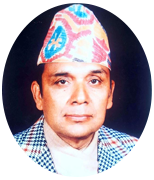
Birth and Family Profile
Dr. Yadav Prasd Pant was born in Kathmandu on November 17, 1925. He was the only child of Mr. Bishnu Prasad Pant and Mrs. Bhisma Kumari Pant. His mother passed away when he was only six years old. He spent most of his childhood in Banaras, India.
At the age of 18, Dr Pant married Rama Pandey aged 12, eldest daughter of Sardar Rudra Raj Pandey and Mrs. Chet Kumari Pandey on June 11, 1943.
Dr. Pant had four children–Mira, Girish, Bhubanesh and Radhesh–and five grandchildren. All of them are engaged in an array of activities related to economics, banking and social services, inter alia.

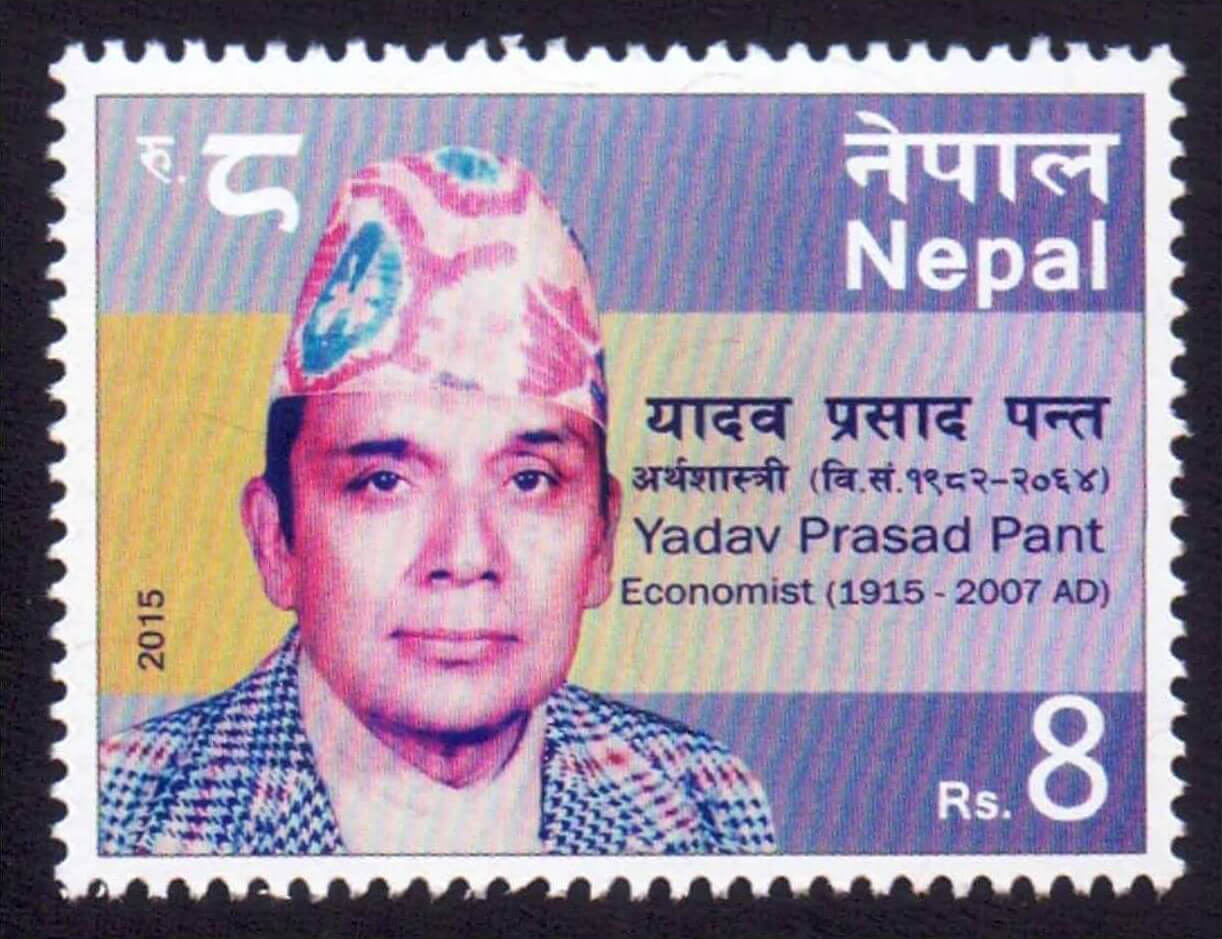
BIO-DATA
Dr. Pant acquired his B.A.from Patna University and M.A. in Economics from Banaras Hindu University (BHU), India in 1946 and 1948, respectively. BHU conferred him a Ph.D in Economics in 1952. In fact, Dr. Pant was the first Ph.D in Nepal. In 1976, he was decorated with D.Litt (Doctor of Letters) by BHU based on his book “Problems of Fiscal and Monetary Policy: A Case Study of Nepal” published by Christopher Hurst and Company, London. Sir Roy Harrod has lauded Dr. Pant in this book stating that “Nepal is lucky to have someone of the caliber of Dr. Pant to explain its special circumstances.”
Dr. Pant served as Professor of Economics between 1953-57 at Tri-Chandra College. He taught courses such as Development Economics and History of the Indian Economy.
Between 1954-56, he was a Member of Nepal’s First Planning Commission and a Senior Member of the National Planning Commission between 1968-72.
Between 1956-61, Dr. Pant was Chief Economic Advisor to His Majesty’s Government and Member of National Planning Board.
Dr. Pant officiated as Secretary, Ministry of Finance and Economic Affairs between 1961-66 and Secretary, Ministry of Finance and Economic Planning between 1966-68.
He was Governor of Nepal Rastra (Central) Bank between 1968-73. Dr. Pant was Founding Chairman of the Bank of Kathmandu (a joint venture with the Siam Commercial Bank, Thailand). He served in this capacity between 1994-98.
Dr. Pant retained several other positions. He served as Chairman of several government-owned corporations including Nepal Industrial Development Corporation, National Commercial Bank, National Trading Limited, Nepal Airlines Corporation, Nepal National Construction Company Limited, Raghupati Jute Mills and Nepal Oil Corporation for a number of years.
He was also Chairman of the Central Pay Commission and the high-powered Central Economic Co-ordination Board instituted by the Government.
In 1979, Dr. Pant was appointed Chairman of Economic Commission for a period of one year.
Dr. Pant served as an economist at UN Economic Commission for Asia and the Far East (ECAFE), now renamed Economic and Social Commission for Asia and the Pacific (ESCAP) between 1957-59. He was the first Nepalese to work in the United Nations (UN) system.
He was Alternate Governor from Nepal at International Bank for Reconstruction and Development (IBRD) between 1962-67 and Governor at International Monetary Fund (IMF) between 1968-73. He was also Governor at IBRD between 1980-83.
Dr. Pant was appointed Nepalese Ambassador to Japan (Residential), Australia, New Zealand, Philippines and Republic of Korea between 1974-79.
Dr. Pant headed the Nepalese mission to numerous international conferences including annual meetings of the Colombo Plan, IMF, IBRD, Asian Development Bank (ADB), ESCAP, Asian Planners’ Conference, and other high-level and ministerial conferences for nearly three decades. He also participated in the Aid Group Meeting for Nepal in 1981 and 1982 and meetings of Nepal-Bangladesh and Nepal-China Economic Commissions as leader of the Nepalese delegation.
Dr. Pant addressed the fourteenth (Honolulu, 1981) and the fifteenth (Manila, 1982) Annual Meeting of ADB as Governor for Nepal and was elected Chairman of the Board of Governors of ADB for the year 1982- 83. Incidentally, he was very instrumental in the establishment of ADB in 1967.
Dr. Pant led the Nepalese delegation to the World Energy Conference held in Cannes, France in October 1986. He was also the leader at the meeting of the International Executive Council held in 1987. He led the Nepalese delegation to an international seminar orchestrated by the Japan-Nepal Society in Tokyo in October 1988. He also participated in the second inter-parliamentary meeting between Nepal and the European Parliament Group that visited Federal Republic of Germany to discuss Nepal-German relations at the invitation of the President of Bundestag in December 1989.
In his personal capacity, Dr. Pant participated in numerous national and international conferences and international expert groups organized by ESCAP, United Nations Conference on Trade and Development (UNCTAD) and ADB, among others. He recounted the “Problems of Least Developed Countries of Asia” in the Round Table Conference of Least Developed Countries co-ordinated by UNCTAD in Bonn, Germany in 1980 and advocated the urgency for transfer of resources to these countries in the spirit of the Brandt Commission Report.
Dr. Pant served as guest professor and speaker at various economic and social institutes, including UN Asian Development Institute, Bangkok, Institute of International Studies and International Education Center, Tokyo and Institute of Social Studies, The Hague.
He participated and served as a guest speaker at the International Forum on Industrialization and Trade Promotion organized by the Korea Development Institute in Seoul in May 1984. He presented the key-note address at a forum organized by the Central Bank of Sri Lanka in Colombo in March 1985. He also participated in the conference of the Asian Economists organized by the Bangladesh Institute of Development Studies in Dhaka in September 1985. He addressed the business gathering at Keindaren in Tokyo in May 1990. HeledtheNepalese delegation to the thirty-third plenary assembly of the World Federation of United Nations Association held in Barcelona, Spain in November 1991 and the thirty-fourth plenary assembly conducted in Geneva, Switzerland in November 1993. He also participated in the thirty-fifth plenary assembly held in San Francisco, USA in 1995. He attended the thirty-sixth plenary assembly held in Calcutta, India in November 1999.
Dr. Pant attended various conferences of Lions Clubs International. He participated in the 26th South Asia, Africa and the Middle East Forum of Lions Clubs International held in Colombo, Sri Lanka in November 1998. He participated in the 83rd International Convention of Lions Clubs International held in San Diego, USA in June 1999 and 27th Forum held in Nairobi, Kenya in November 1999.
He was a Member of the Continuation Committee of the Rehovot Conference and of the Preparatory Committee of the Asian Economic Association during 1961 to 1964. He was a Fellow of the International Bankers’ Association and also a Honorary Member of the International House of Japan.
Between 1990-99, Dr. Pant was Vice-President of World Federation of United Nations Association, Geneva. Commencing from 1997, he served as Executive Member. Dr. Pant has traveled extensively over all parts of the globe.
Between June 1980 to July 1983, Dr. Pant served as Minister of State for Finance and General Administration and Minister of Finance, Commerce and Supplies. He was a nominated member of Rastriya Panchayat (National Assembly) from June 1980 to May 1986.
In May 1986, Dr. Pant was elected with an overwhelming majority to the Rastriya Panchayat from Nawalparasi Constituency, Western Nepal. He served as Minister of Water Resources from June 1986 to October 1988. Subsequently, he continued to remain as an elected member of the Rastriya Panchayat until March 1990.
Dr. Pant was the Founder Member of the Rastriya Prajatantra Party (National Democratic Party). He was Vice-President of the Party between 1990-93 and Central Treasurer between 1993-99. Dr. Pant was voted Executive Member of Pacific Democrat Union. He attended the Pacific Democrat Union Conference held in Sydney in early March 1994 as an observer and got the Rastriya Prajantantra Party admitted into its membership. He also participated in the Leaders’ Conference of the International Democrat Union held in Seoul in 1995 and managed to get the Party selected as Executive Member.
Dr. Pant worked in a number of cultural and social enterprises. He performed as Chief Editor and Executive Member of Nepal Council of Asian Relations and World Affairs for a number of years. He was also the Founder-Secretary of Nepal Institute of Economic Studies.
In 1962, Dr. Pant became Life Member of Nepal Red Cross Society and was First Vice-President between 1962-67. He was a Chief Advisor until 1995.
From August 1968 to 1972, he was the Honorary Treasurer and Member of Senate of Tribhuvan University, Nepal.
He was the President of Nepal Chapter of Society for International Development from 1979-85.
He had been the founder President of the Nepal-Japan Friendship and Cultural Association since 1979. He was the President of the United Nations Association of Nepal between 1979-96. He was also the Vice- President of the Nepal International Centre which was founded in 1991. Since 1985, he was the Executive Life Member of Nepal Cultural Association and Chief Advisor since 1999.
Dr. Pant played a key role in the formation of Rudra Raj Sahitya Samiti, a cultural organization, in 1988 and served as its Chairman for eighteen years.
He was Vice-Governor and District Governor of International Association of Lions Club, District 325 B Nepal, Commencing from 1996, Dr. Pant served as Councilor and Honorary President, World Federalist Movement, New York.
In 1999, Dr. Pant was elected Chairman, Nepal-Scandanavian Chamber of Commerce and Industry. Dr. Pant was also a Life Member of the International Society of Krishna Consciousness (ISKCON).
What people says about Dr. YP Pant
PUBLICATIONS
Dr. Pant has made valuable contributions to the theoretical and pragmatic problems of economics, his fields of special- ization being fiscal and industrial growth, economic planning and international trade.
Principles of Economics
(in Nepali), 1955, Indian Press, Allahabad.
Population Trends in Nepal
(in Nepali), 1955, Nepal Council of World Affairs, Kathmandu.
A Study in Industrial Location
1957, New Book Company, Bombay.
Planning for Prosperity in Nepal
1957, Cultural Association, Kathmandu. Second Enlarged Edition, 1962, Varanasi. Third Revised Edition, Sahayogi Prakashan, Kathmandu.
Fourth Completely Revised Edition, 1975, Sahayogi Prakashan, Kathmandu
Nepal’s Economic Development on International Basis
1957, Varanasi. Second Edition, 1962, Kathmandu.
Nepal-China Economic Cooperation
1962, Department of Publicity, His Majesty’s Government, Kathmandu.
A Decade of Planning in Nepal
1963, Department of Publicity, His Majesty’s Government, Kathmandu.
Economic Development of Nepal
1965, Kitab Mahal, Bombay
Agricultural Development in Nepal
(in collaboration with Dr. S.C. Jain), 1969, Vora and Company, Bombay. Second Revised Edition, 1979.
Problems in Fiscal and Monetary Policy: A Case Study of Nepal
1970, Christopher Hurst and Company, London.
Banking and Development
1971, Nepal Rastra Bank, Kathmandu
Long-Term Planning for Agriculture in Nepal
(in collaboration with Dr. S.C. Jain), 1972, Vikas Publishing House, New Delhi.
Problems of Development of Smaller Countries
1974, Oxford & IBH, New Delhi.
Regional Imbalances and Process of Regional Development in Nepal
(in collaboration with Dr. S. C. Jain), 1980, Development Publishers, Berlin
Rural Problems and Rural Development in Nepal
(in collaboration with Dr. S.C. Jain), 1980, Development Publishers, Berlin.
Population Growth and Employ- ment Opportunities in Nepal
1983, Oxford & IBH, New Delhi.
Planning and Development
1990,Oxford & IBH, New Delhi.
Trade and Co-operation in South Asia: A Nepalese Perspective
1991, Vikas Publishing House, New Delhi.
North South Dialogue: Some Issues and Options
(in collaboration with Dr. B.P. Pant), 1995, Vikas Publishing House, New Delhi.
Some Aspects of Economic Planning: A Case Study of Nepal
(in collaboration with Dr. G.P. Pant), 1998, Vikas Publishing House, New Delhi.
Dr. Pant has published more than 300 articles and research papers in various journals and newspapers, both international as well as national.