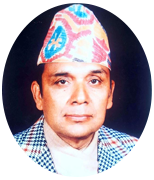
Economist To The Core
P. Kharel
Senior Journalist
Dr. Yadav Prasad Pant. The name recounts the story of an economist to the core, someone who made his academic pursuit and career in the field of his chosen specialization with remarkable distinction. Dr. Pant progressed from a variety of services. In addition to being Governor of Nepal Rastra Bank and Finance Minister, he was also a national legislator. He gave lectures at Tri Chandra College for a number of years and also served as Ambassador to Japan.
The national literacy was in the bottom half of a single digit when he did his doctorate. It was also a time when Economics was not the most favourite subject of the few Nepalese students who pursued university education. The number of students completing Master’s was extremely few and the ones pursuing doctorate almost nil. Dr. Pant was made of a different stuff and was amply rewarded for his patience and pursuit. Economic issues were his staple that earned him success and wide recognition.
In the course of his career as a news reporter and columnist since the 1970s and 1980s in particular, this information hound had numerous encounters with Dr. Pant who addressed various public functions, held press meets and had private chats. He talked a lot of sense-something not easily available even today. To media queries, his response was succinct and respectful. In a society where controversies court public figures rightly or otherwise, the late Dr. Pant had a remarkable record of being free from such distractions.
In a society where controversies court public figures rightly or otherwise, the late Dr. Pant had a remarkable record of being free from such distractions. In this regard, he had an enviable record compared to quite a few of his peers. In his stint in multiparty politics, he served as Vice President and Treasurer of Rastriya Prajatantra Party. Contemporary history judged him commendably and so will it be in the ages to come.
Sincere tribute to Dr. Pant who did so much for a sector that had so few experts and so little expertise during the several decades when the great economist was at his prime.
In Memory
Padma Jyoti
Member, Constituent Assembly
In the making of any country’s institutions, a few men and women always play a vital role. These institutions provide the framework for the activities of different sectors of the society. They are the building blocks of rule of law and good governance. In shaping the kind of modern Nepal that we live in today, a few illustrious people have played a pioneering role. Dr. Yadav Prasad Pant was one of such men.
When I was still a young student, who used to come home to Nepal, I recall distinctly the times I visited Doctor Saheb with my father, late Maniharsha Jyoti. My father knew him well and they worked together on a number of industrial, economic and social groups and tasks. They had friendship and an association based on mutual respect and shared values on development of Nepal. My father used to take me along whenever he visited people he respected and held in esteem, perhaps as a way to inspire and educate a young son like me.
My memory of Dr. Pant is that of a genial, soft spoken and very wise man who could look at an issue in a balanced and cool manner. You felt relaxed and at ease in his presence. He had a demeanor of calm amusement with a smile seemingly just under the surface about to radiate out. I still remember this wonderful aura that seemed to emanate from him. Such an impression was only possible as a result of his lifelong scholarly achievements and sharp intellect. He represented the highly educated, intelligent and brilliant breed of modern Nepali which had started to emerge then. Nepal needed then and needs now many sons and daughters like him.
He served our country with distinction in a myriad of fields including economics, in which people like me are involved. He shared with the community what he possessed. This quality of character illuminated his life. His quiet and selfless philanthropy has benefitted many social organizations who remember him with gratitude.
The political weather and the times change in any country. But there is no denying the fact that we grew up and lived through those days which placed Nepal on the modern world map as a full- fledged state. All of us are products of those days, of the inherited legacy and history. We salute with admiration and remember with affection all those who played a part at the forefront of nation building with dedication, sincerity and hard work. I consider myself fortunate to have known Dr. Yadav Prasad Pant.
Role in Bank of Kathmandu
P.P. Rauniar
Tourism Expert
The infra are the initiatives taken by our respected late Dr. Y.P. Pant in the establishment of Bank of Kathmandu (BOK).
(1) After the fall of the Panchayat system, some of us opted to acquire a license to operate a domestic airline. However, this did not materialize.
(2) During the discussions, Dr. Pant recommended to go for a private commercial bank.
(3) A meeting of about 20-30 like- minded people were invited by him at his residence where he placed the proposal.
(4) Everybody appreciated his inputs and ventured to move forward under his dynamic leadership.
(5) After a couple of days, a committee was formed in which Mr. B.R. Singh and Mr. Bishwamber Man Shrestha were included.
(6) Dr. Pant took a lot of interest and pain and travelled to Tokyo, Hong Kong and Bangkok to utilize his influence and contact to have a joint venture with some internationally reputed banks.
(7) An office was established in Kamaladi for the spadework to register the bank.
(8) After a couple of months, BOK came into existence under the chairmanship of Dr. Pant and the promoters were divided into five different groups.
(9) He took a lot of initiatives to complete partnership with Siam Commercial Bank, a globally reputed bank based in Thailand.
(10) Since Siam Commercial Bank could not remain long in Nepal emanating from some technical reasons, BOK came 100% in the hands of Nepalese management.
All in all, BOK is the creation of late Dr. Y.P. Pant. His contribution in its formation will always be remembered by all of us with great respect.
A Thorough Gentleman
Prabhakar SJB Rana
Senior Industrialist
I came to know Dr. Y.P. Pant quite early in my adult life. As he was one of our early respected economists, it was natural for a young man coming into the real world to seek his views on different aspects of national life.
Dr. Pant was an erudite and a learned man not only on his own field of expertise but also on other subjects of relevance. He was a man of quiet disposition. His contribution to our national life has many imprints but always with under tone value.
In actual work-related field, my association with him was few and far. When he was Finance Secretary, Soaltee Hotel was being built. Whenever certain discussions concerning his ministry arose, I always got a full hearing followed by prompt responses for which I am grateful.
I came to know him as a person more when we were both involved in the establishment and growth of Nepal Red Cross Movement, which was spearheaded by my eldest sister, the late Princess Princep Shah. She greatly valued Dr. Pant’s advice as well as fully committed participation.
Later, when he joined main political stream, we kept our relation on an even keel. His vast experiences on both theoretical and practical aspects, I am sure, was of much help to his chosen party.
In addition, his hands on involvement in commercial banking in the open market must also be recognized.
His unexpected and early demise has been a loss to our economic and public life. My remembrance of him will always be of a thorough gentleman with much depth both in his learning and day-to-day life.
A Great Human Being
Dr. Pradeep Bhandari
Senior Medical Consultant, UK
We cannot ask for respect, it just has to be earned. The way our cultural and societal structure is, the respect people in authority seem to command and enjoy is mostly the result of the dominance and power they can exert on ordinary people who are traditionally tuned to show a fake administration towards these so-called great people. I believe for the aforementioned reasons that there are in fact only a handful of real celebrities in our society who deserve true respect that comes right from the hearts of people; and without a shadow of doubt, late Dr. Yadav Prasad Pant was one of those few people.
Dr. Pant indeed held high offices and positions that have influenced the course of the nation and the lives of all of us consequently. The contributions that he has made are certainly commendable, and it is not surprising for people to have a natural admiration for him. I have had several opportunities to interact with him and observe him from close quarters outside his persona as a successful and able statesman that justifies people’s admiration for him. He was not only a selfless person who had the necessary education, experience and devotion geared towards the welfare of the country and its people, but also a great human being who led a simple life, possessed a humble personality, and had a unique but great sense of humor. Most of my meetings with him had been at times when he would be very much at ease and in his most natural self, without any sort of stress related to his political or other obligations. At those moments, when I would even be left alone with him without other members of the family around, I could just not help but observe, listen and appreciate the simplicity of his thoughts, see the funny side of his nature, and notice the naivety within his personality. He was a caring and kind person whose words were soothing to the ear and touching to the heart. The way he would explain and narrate things in his distinctively humorous manner during such times puts a smile in my lips even to this day. I can still visualize the way he looked in his ordinary attire at home, and can hear his voice clearly too, whenever his memory strikes my mind. Looking back at those valuable time with this great man, I wish I had more opportunities of being around with him to learn from his tales and experiences in life that would have educated more and taken me closer towards becoming as humble a human being as he was.
I wish to take this opportunity in praying for the peace of the departed soul and in expressing my desire that some of us who truly admired and respected him could continue his legacy, be able to gather similar respect in course of time, and leave behind many good memories in people’s minds just as he has done.
An Icon of Visionary Devotion
Mrs. Prem Kumari Pant
Senior Journalist
I got a chance to get acquainted with late Dr Yadav Prasad Pant some forty years back. I must assert the fact his gentleness and generosity enthused my soul from the very first meeting.
So, when the melancholic news about his death circulated more than a year back, I was literally distraught. Whenever the memory of this epitome of erudition strikes me, I visualize his vivaciously composed personality. At the same time, I feel the warm and inspiring munificence he showed towards me during my several meetings with him.
The late Dr Pant was indeed a man with profuse knowledge and focused vision. I elatedly consider myself lucky when I reflect upon his wise words that have also encouraged me to follow the smart paths.
It will be sheer injustice not to hold his contributions towards the greater good of the country in high regard. The steadfast and industrious efforts he made to uplift the status of the country, indisputably, deserve standing ovation.
Dr Pant started leveraging his diligently gathered knowledge on the economy with an aim to propel the country towards the path of planned development. In the 1950s, he acted as Chief Economic Advisor to the then Congress Government. Dr Pant also assumed the role of Senior Member of the National Planning Commission (NPC) in 1968 and contributed substantially to materialize the concept of planned development of the country.
In a linear fashion, he also played a crucial role to energize the economic realm by holding various senior posts such as Secretary of Finance and Economic Planning in the 1960s.
During his tenure as Governor of the Nepal Rastra Bank (NRB), the bank was acclaimed as one of the best banks in the world by Switzerland. Similarly, the initiations taken by Dr Pant to buttress the economic development of the country were also prominently acknowledged by various noted international economists. These recognitions duly corroborate the fact that Dr Pant was an economist with uncommon vision and indomitable passion for excellence.
Dr Pant possessed enough dexterity and agility to align his tasks with the shifting paradigms of the global economy. He also firmly believed that the involvement of private sector is imperative to expedite the economic development of the country.
Undeniably, Dr Pant, with his unmatched knowledge on economy, also played a laudable role in enabling Nepali economy to occupy due space in the protocols of global and regional financial institutions like World Bank, International Monetary Fund and Asian Development Bank, among others.
He had also made devoted and focused attempts to impel the foreign countries to extend support to Nepal in its development endeavors.
Dr Pant also acted as Minister of various ministries such as Finance, Commerce and Supplies and Water Resources in the course of his outstanding career.
The yet another vivid dimension of the personality of Dr Pant is that he was also a successful diplomat. He served as Nepali
Ambassador to different countries like Japan (Residential), Australia, New Zealand, Philippines and Republic of Korea. During his role as a diplomat, Dr Pant determinedly honed his diplomatic skills for the greater interest of the country.
Benevolent, polite and gracious, Dr Pant was also equally enthusiastic to devote himself for the well-being of society. He satisfied his pious desire to work for the enhancement of social fabrics by acting as Chief Advisor of Nepal Red Cross Society and President of UN Association of Nepal and Society for International Development, Nepal Chapter, to name a few.
Dr Pant had been bestowed with various prestigious awards for his profusely positive and proactive contributions in the economic and diplomatic realms of the country. This multidimensional personality had also authored more than twenty books in English and Nepali about the diverse economic aspects of the country.
All in all, the country should always hold this luminary in the highest regard so that the new generation will find a sensible meaning to dedicatedly contribute to the greater good of their motherland. Dr Pant, undeniably, stands as a beacon of inspiration for the young people to follow the path that is distinctly theirs.
Economist’s Economist
Dr. Raghab D.Pant
Former Vice-Chairman,
National Planning Commission
It is difficult to write about Dr. Yadav Prasad Pant who died on November 14, 2007. To criticize him, to rewrite the sentence once used by Mr. Walter Heller in a debate with Prof. Milton Friedman, the Nobel Laureate, is impossible and to praise him in the limited space available to us now is another impossible job. He was the first Ph.D. in Nepal. He was the first to join the international service. He was first Nepali to hold the position of the Chairperson of the Asian Development Bank. He was first in so many areas not only in Nepal but also in South Asia. He was, in a true sense, the economist’s economist. Sir Roy Harrod has correctly summarized his academic depth in one sentence: “Nepal is lucky to have someone of Dr. Pant’s caliber”.
Pierre Paul Schweitzer, who was Managing Director of the International Monetary Fund in the seventies, regarded him as one of the best administrators and economists. Once, Mr. Tribhuban Nath of the “Times of India” asked him about the activities of the Nepal Rastra Bank when Dr. Pant was Governor of that bank. Dr. Schweitzer’s reply was very brief, “It is one of the best central banks of the world”. It was printed next day in the front page of the “Times of India” at that time.
Once, a two-hour seminar was organized at his initiative. I was also invited, though a fresh student just out of the university. The main speaker was close to him, and spoke very highly of him. He gave a good lecture on foreign trade. He was Dr. Jagadish Bhagwati, who was then Professor of Economics at MIT, and married to Ms. Padma Desai, who was Professor of Economics of Comparative Economic System at Columbia University. Dr. Pant’s contact with international economists was, to the best of my knowledge, very wide–a subject that needs to be explored in the future.
He was many things for many people. We invited him at our residence on 23 December, 2006 to attend a family festival. He, as simple and modest as he was, not only graced the occasion but came on exact time. He was in a very relaxed mood as usual. (I never realized it would be our last meeting). He shook my hands in a very friendly manner. We had a brief talk with him about ethics in economics; and he gave even a brief analysis of interrelation between Karma and Destiny- a very complicated issue. Our question was: “Can one live, believing in Karma and Destiny?” His answer was in affirmative. Now the question is: will we also agree with him?
It was difficult to dispute over Dr. Pant’s argument; he had the capacity to convince even the die hard opponents. He was the only son of his father but lost his mother when he was a child. His father was almost a saint. He used to live in Banaras (now Varanasi) and Kathmandu. Most of the time, he was involved in religious practices. As a result, Dr. Pant was educated in Banaras, like many of the people of his time. He received his doctorate in economics also from Banaras Hindu University. He was the second Nepali to receive D.Litt degree after late Dr. Dilli Raman Regmi.
He started his academic career immediately after the completion of his study. He did not seem to care for his landed property. He joined Tri- Chandra College as a Professor of Economics, and then became the Member of the Planning Council in 1954 that helped to prepare the First Five Year Plan. It was the beginning of a journey that saw him as Chief Economic Advisor of the Nepal Government, Secretary of various ministries, Governor of the Central Bank, Minister, Ambassador, to name a few positions that he held. He died at the age of 82. Like Mahatma Gandhi said birth and death for him were not two different states, but they were different aspects of the same state. His karma is still with us to read, learn, and, most important of all, to think differently as he did in his several books, articles and many reports.
His first book was on planning. In 1954 or 1955, when I was a kid I first saw him in Varanasi at his rented house at K 22/59, Durga Ghat. My father, who used to work for the management of Dr. Pant’s landed property which was scattered in several places of the country, was also staying there. I was very impressed when I first saw him. He was very handsome, just like a film star of that time. I was told that he was an excellent swimmer, who had the courage and energy to cross Ganga by swimming. I found him most of the time either reading or typing. My father told me that he was writing a book which was to be published soon. I realized after several years when I was in college that book was “Planning for Prosperity in Nepal”, the first book on planning in Nepal.
He will, however, be remembered more, at least by the economic historians, as a man who helped to establish the fiscal base of the economy and to introduce fiscal policy as an instrument of national development. His contribution in the fiscal policy has yet to be explored in detail. He only knew how difficult it was to formulate and implement fiscal policy even with total support of the political leadership. I will recommend ‘Dr. Y.P.Pant Research and Development Foundation’ to undertake this activity. Let it be the first research activity of the Foundation.
Similarly, his contribution in the monetary field cannot be underestimated or minimized. He helped to establish the root of the country’s monetary system. When he joined Nepal Rastra Bank in 1968 as its Governor, there was no provision of Deputy Governors. He appointed two Deputy Governors–one from inside and one from outside. He expanded research activities of the central bank, and for the first time in the country, he initiated a survey of national rural credit. A national seminar was organized with the participation from both public and private sectors. These activities, to name a few, and his national and international image helped to turn Nepal Rastra Bank as an independent institution for the formulation and implementation of monetary policy–a system that is so dear to us, myself included. In that process, Nepal Rastra Bank emerged as an Economic Advisor of the government. He started a process of submitting a comprehensive “pre-budget report” to the Ministry of Finance to help it to prepare a realistic annual budget–a process, I guess, is still continuing.
His academic works, however, have not much been discussed in recent years. His book “Fiscal and Monetary Policy of Nepal” published from London clearly provides our stage of knowledge at that time on the two important national policies available to the Government for the growth and development of the country. He completed that book–I was associated with him at that time–in one and half months.
There are so many ‘new’ works that he had initiated. How long can we continue? He was of a different intellectual capacity, and that is why his colleague, Dr. Bhekh Bahadur Thapa, also calls him his “Guru”. It was perhaps a strange and extravagant task at that time for an individual to initiate but it was a difficult task–who would deny that? It is, therefore, not an exaggeration to claim that he is, he was and he will be “The Economist’s Economist”.
Fond Memories of Yadav Buwa
Dr. Rajesh Panth
Senior Medical Doctor
The thought of Yadav Buwa will always continue to bring back fond memories in me.
His signature in every rupee note I possessed as a growing child was always a source of pride for me. I used to show off in front of neighborhood friends by deliberately reminding them that the notes they possessed bore signature of my governor uncle.
His discussion about politics with my father was always a curious topic for me. I always had the impression that he was privy to information about politics that my father did not have and he somehow was always correct in his analysis. As he was the eldest of the siblings among my uncles and aunts, I was at times in awe of him. I thought he somehow was more proper than the rest and demanded and deserved more acceptable views and behavior.
His visit to Dhaka as Finance Minister in the early eighties, when I was doing my MBBS, was my first opportunity to know him on a personal level. He invited Reeta, my wife, and me to the guest house he was residing in for breakfast. He was very jovial at the dinner party hosted at the Embassy in his honour.
My interaction with him about his health as a medical doctor always provided me with a topic that interested both of us. It was nice when he let me know that he would follow my medical suggestions. His appearance was never predictable and he pleasantly surprised many of us and even me as a doctor when he suddenly looked fitter and healthier than his previous self many months before.
The jewel in the crown that I will always cherish is the get-together he organized for tika during dasain for the last so many years. His large living room at his Kalikasthan residence would be chaotically but thrillingly crowded by our large family circle for the ceremony. The flush card game that followed a delicious dinner was always one of the main attractions of the year.
When Yadav Buwa was flown to Bangkok for his treatment. I really hoped and believed he would surprise us once again. Surprise us he did, but this time drastically differently than many times before.
We always cherish the nice time we had together and continue to have fond memories of him for as long as we celebrate dashain.
Looking Back at Dr. Y.P Pant
Dr. Ram Sharan Mahat
Former Finance Minister
Member, Constituent Assembly
Dr. Yadav Prasad Pant was a prolific writer. I started perusing his writings from my teens when I was a college student. I passed college and university degrees, but there was no escape from Dr. Pant’s books. He continued to churn out new creations on banking, monetary and fiscal development, planning, poverty etc. The books invariably became text books or reference materials on Nepali economy from the intermediate to post-graduate level. Furthermore, one could not avoid books he wrote even when one was doing Ph.D dissertation on one or the other aspect of the Nepali economy. Those were the days when there was a dire paucity of literature available on the Nepali economy, a significant portion authored by him. One cannot help appreciating the hard work of the man who despite the rigours of various official responsibilities continued to contribute to enrich the limited body of literature on the subject. This hard work and academic discipline are all the more noteworthy from a man who came from the upper crust of the society and was born with a silver spoon in his mouth.
Dr. Pant was among a few Nepalis with higher education in the early fifties. He was the first Ph.D degree holder. Responsibilities in the government came naturally to him at a time when expertise was a rare commodity. He taught economics in Tri Chandra College, and during B.P. Koirala’s government, was Economic Adviser to the legendary Finance Minister Subarna Shamsher Rana. General Subarna Shamsher had the distinction of being Nepal’s first Finance Minister who also introduced the budget system in the country by presenting the first budget to the legislature in 1952. Dr. Pant represented Nepal in UN/ ECAFE meetings and was instrumental in organizing an international meet in Kathmandu. Later on, during the Panchayat era, Dr.Pant became Finance Secretary, Governor of Nepal Rastra Bank, Ambassador, Member of Rastriya Panchayat and Finance and Water Resources Minister. He performed his job with dedication, hard work and integrity.
Kathmandu’s intellectual circle is limited. I had therefore opportunities to know him closely for professional interest. He was a thorough gentleman refined to the core. Soft spoken and courteous to others, he was always eager to expand his knowledge. There was also an indefatigable fighter in him which his humility and gentle manners did not reflect. He joined the rough and tumble of politics in the latter part of his life. He jumped into electoral fray successfully in the pre 1990 era. He also tried afterwards in the post-1990 dispensation. My friends from Nawalparasi tell me how vigorously he was canvassing and campaigning, despite his age and failing health.
The last time I saw him was when he was laying in the intensive care unit in Bumrungrad Hospital in Bangkok which turned out to be his death bed. He was in almost unconscious state. He looked at me but I cannot say if he recognized me. After a couple of weeks, the news came that he breathed his last. In his death, the country lost an enlightened gentleman who served his country with distinction at a time when the likes of his breed was in limited supply. He was a true nationalist. May his soul rest in peace.
Thulo Buwa in Memoriam
Dr. Sharad Bhandari
Senior Economist,
Asian Development Bank
My memories of Thulo Buwa consist of shifting images from the 1960s until the early 1980s, when I was growing up in Nepal, and from my visits to Nepal until 2007. During the early years, my brother and I spent a lot of time with our cousins at his house. I remember Thulo Buwa as extremely busy during those years, working diligently to fulfill his responsibilities in the various high-level positions that he held. He seemed to me, even as a child and an adolescent, to be very fastidious in his appearance, always well-dressed whether in traditional Nepali clothes or Western ones. This was probably, at least in part, a reflection of his work ethic, and certainly consistent with it. His integrity impressed us even at an early age.
He seemed to be happiest and most relaxed when he was spending time with family and friends. When I think back on those years, I remember his kindness especially towards those who had fallen on hard times. He had a few indulgences. The ones I remember the most were his fondness for Hindi movies, for french fries (aloo tareko) and dried mango, for new technology, and for branded clothes and accessories – I was chided once, with an undercurrent of humor, for bringing him as a gift from America a shirt that was of a lesser brand than he preferred.
He kept a healthy balance between tradition and modernity, holding to his cherished religious and cultural beliefs instilled in him during his formative years. Simultaneously, he was pragmatic in adapting to changing times and in accepting others’ values even when they did not concur with his own. I did not see much of my family and friends in Nepal after I went to America in 1983 for studies and, subsequently, for work. But during my visits to Nepal from America, and from Singapore and Manila where I have worked since 2000, I was struck by Thulo Buwa’s curiosity about everything from foreign cultures and new gadgets to developments in financial markets. He used to reminisce about his experiences from his travels around the world to provide some perspective and contrast to more recent developments.
His enthusiasm for life did not seem to diminish even as he grew weaker with age and, towards the end, with illness. Although he was unable to do many of the things that he might have wished to, his level of interest in goings-on remained high. The final image I have of him is from the time I visited him at the hospital in Bangkok at the very end of his productive and full life. He was feeble and unable to speak. But I knew he recognized me even before Didi mentioned to him that I had come to see him. I could tell from the smile in his eyes.
Memories of Thulo Buwa
Shailesh Bhandari
Free-Lance Senior Consultant,
San Francisco
One of the more interesting memories I have of Dr. Y. P. Pant, or Thulo Buwa as I used to call him, was around twenty five years ago. It was sometime after midnight, and I was returning home in my bike after watching a Hindi movie on video. These were halcyon days and nights in Kathmandu, which was quite possibly the safest city anywhere at that time. As I sped my bike to go home, Thulo Buwa’s car arrived. He walked up to me and, in a sigh of relief, said “Finally, I took care of this budget mess”. I was quite amused, since it was not his style to confide in a teenager. He was at that time the Finance Minister, and I felt a bit of pride that the person in charge of running the treasury of the country had just told me that he was feeling good about the budget.
In the late 1970’s and early 1980’s, I remember his house would accommodate a constant stream of visitors. People from all walks of life would continuously come and go–many of them were relatives, some were colleagues and employees in his ministry, and others were job-seekers from all parts of the country. His generosity and hospitality comforted all the visitors. Before returning home from school, I would really look forward to taking a break there and meeting various people.
Politics was one strong passion of Thulo Buwa. However, I never saw him as a politician. He was an individual who inspired his friends and relatives to lead an honest and righteous life. His closeness with his father-in-law (my maternal grandfather), Sardar Rudra Raj Pande, bolstered his spiritual orientation. When I returned back to Nepal to visit my family and friends, I would go and meet him, and talk to him about politics, religion and many other topics. He would open up and talk about how the country had been afflicted by violence. The direction of the country had taken a turn for the worse, and he was worried that the leadership coming from all political fronts was tainted with extreme selfishness and opportunism.
I was also struck by his love for life and his work. Even in his final years, he remained very active, and made significant contributions to the institutions of his interest, such as, the Lions Club, Nepal Japan Friendship and Cultural Association and the Rotary Club. It was not unusual for the octogenarian to fly to Bharatpur to attend one meeting, return to Kathmandu the next day, and fly the following day to Biratnagar for another meeting. He also kept abreast of the important events around the country and the world.
When I heard from my parents in the late summer of 2007 that Thulo Buwa had started to get ill, I did not think for once that it was very serious. After all, this was a man who would keep himself very fit and busy, and the only sign of very old age that he showed was in his slightly bent posture. When I last saw him in January of 2007, he seemed radiant and handsome. But his health had started to get worse. Then after suffering lung infections, he was flown to Bangkok. I was following news of his deteriorating health from afar. It was also the time that we were welcoming a child into our family. At that time, I felt great joy that a newborn was coming into this world, but I was also deeply saddened that one of the people I had admired in my life would probably not be with us anymore. I ruminated upon Thulo Buwa’s life at that moment. He had lived a good life, a blessed life; and I consider a great fortune on my part to have known and interacted with such a decent human being.
A Very Good Teacher
Professor Soorya Lal Amatya
Rector, Tribhuwan University
Dr.Yadav Prasad Pant initiated his career as a teacher of Economics at Tri-chandra College. He had earned a Ph.D. degree in Economics in 1952 from Banaras Hindu University. He was a very good teacher. I still remember his method of teaching in early 1950s. Tri-chandra was then the only college of higher learning in Nepal. He used to deliver a lecture for about 35 minutes covering topics as specified in the syllabus of Patna University. After his lecture, he used to dictate for about ten minutes the information and teaching materials that he elucidated in his lecture. The information and teaching materials that he lectured and dictated were useful for the purpose of examination for three reasons. First, the books were not available. Second, we could not afford to buy prescribed books. Third, the syllabus incorporated topics with reference to India in general and the state of Bihar in particular. There was a dire paucity of information in those days. So, the students had to hinge on class lecture and dictation provided by the teachers.
I was one of the brightest students in Economics and Geography at the Bachelor’s level. Dr. Pant used to conduct periodic examinations in the class. I used to secure the highest marks in such examinations. Once it so happened, in one of the periodic examinations, we needed to answer three questions out of four. I had written answers of two questions at length. Since I did not have time to answer the third question at length, I gave the gist of the answer covering the important aspects. However, I secured the highest mark. A number of my colleagues complained to Dr. Pant how could I secure such mark when the answer was incomplete. His reply to my colleagues was very simple and cogent. The two answers were very remarkable and the third answer, although brief, covered all the vital aspects though it could not be written at length due to time constraint. All my colleagues were satisfied with the reply. Indeed, Dr. Pant was an excellent teacher in Economics.
After I completed Master Level Study in Geography at University of Baroda, I had an opportunity to work as a Section Officer in the Ministry of Economic Planning, HMG, from 1959-1961. Dr. Pant was then a Member of the Planning Board. He was very active and made substantial contributions as a Planner, Economic Adviser, Secretary, Governor, Ambassador, Minister of Finance and Water Resources and in different other positions. He was a research-oriented person and has written many books and articles.
He also supervised Ph.D. students in Economics. I recollect when I was Dean of the Institute of Humanities and SocialSciences, Dr. Pant attended a Ph.D. Viva Voce program when he was Minister of Finance and defended a few statements of the Ph.D. candidate.
To conclude, Dr Yadav Prasad Pant was a remarkable teacher, planner, administrator, banker, diplomat, politician, economist, and a person of extraordinary capacity and vision.
Reminiscences of an Icon in the Nepali Landscape
Sriram Raj Pande
Senior Economist,
United Nations Development Programme
My recollection of Dr. Yadav Prasad Pant goes back to the time I was a little child. His passing away in November 2007 was not only a great shock to all of us who had the privilege of knowing him from close quarters, but to the country as a whole. That day, Nepal lost one of its most illustrious sons, a man whose contributions to the country can be paralleled only by a handful of people. This is a man who should be placed at the top of the list of those who dedicated their lives for the betterment of the country and its people and who represented Nepal so well in so many international events.
Dr. Pant was a man of great erudition. His fondness for the latest books and articles spread over to you and encouraged you to also read more. Whenever some new publications of the UN came to his notice, he would ask me “where is my copy?” and I always made sure I made available anything new I had access to. He would be so happy to receive those, a real testimony to his constant thirst for knowledge.
I have always remembered Dr. Pant to be very active and busy attending to matters of the state and later social work and travels. He had a distinguished career in government and served well in many important positions as Secretary in different ministries, Member of the Planning Commission, the Governor of Nepal Rastra (Central) Bank and Nepal’s Ambassador to Japan. Even after his retirement from the Government, he joined politics and for many years became an active politician. He served the country as Minister of Finance and Water Resources for several years and later continued to lead an active life as a social worker until the very end. I also saw he always had time to be with his family, which was quite a feat given how much he was engaged in his official work and also surprisingly found time for constant study.
Dr. Pant was an urbane, highly sophisticated and polished individual. He got along with everybody, putting even the most ordinary man at ease. When we shifted our home to Manbhavan in Jawlakhel some five years ago, he liked to drop by frequently to visit my parents and I do recall how warm a relationship he had with them. I always felt so refreshing to sit down with him and talk about current affairs. He was a man who led a rich and fulfilling life. I take this opportunity to salute him.
A Jewel of the First Water
Professor Yubaraj S Pradhan
Former Registrar,
Tribhuwan University and Ambassador
It is my privilege to express my feelings for Dr. Pant, who is, sad to say, physically no more with us, yet always with us in our memory by virtue of his exemplary life and invaluable contributions to this country and society. In this write-up meant to be published in the commemorative volume, I will shun to give biographical details, which I leave for other writers. I will just confine myself to a brief mention of my impressions of him, with whom I was associated in different capacities. The most remarkable thing about him was his dynamic multifaceted personality. He made his marks in various fields. He was at once an academician, author, economist, politician, diplomat, planner, administrator, banker-all rolled into one.
To begin with, his academic stature can be gauged by his five-year stint in teaching as a Professor of Economics at Tri-Chandra College. Around 1950, educated people used to be a rare commodity in our society. A graduate easily became the talk of the town. In that period of history, earning a PhD soon after post-graduation was really a feather in his cap, which shines all the more when you are told that Dr. Pant had set a national record by being the first PhD of the country. And the award of a DLitt, after sometime, further corroborates his academic soundness. The authorship of several books on economics, planning and monetary policy also forms part of his academic achievements. Special mention has been made of his academic contributions because it has jacked him up to success in all other fields. His weighty educational accomplishments gave him easy entry to various positions. He didn’t need to look for jobs; on the contrary, jobs waited for him, and he could afford to be selective. While saying this, another noteworthy aspect about Dr. Pant’s life comes to the fore: once he embarked upon his career after completing his education, he went on and on, without looking behind and never knowing any break or respite. He is one of the very few people in the world whose life was not afflicted with ups and downs. He never tasted what failure is like. His story of life was a rising graph of success throughout. He was tipped from one position to another with hardly any interregnum.
Throughout his career, he was conspicuous for his integrity, clean image and impeccable character. He hardly gave an opportunity to anybody to cast a slur on him. Though he was a leading figure in the world of finance most of the time, he was always free from corruption scandals, which is quite unusual and exceptional for our society. Though his assignments lent him an opportunity to wield enormous power, he was never arrogant and overbearing. He didn’t ever lord it over his colleagues, nor he rode roughshod over the wishes of other people. As an administrator, he always had a positive attitude. It was not his habit to harass the people by holding files unnecessarily. He would be happy in helping the people out. When the attitude is positive, it is not difficult to find the way out. And when there is no hanky-panky at the top, it has an overpowering effect up to the bottom. He was a gentleman, but not a fool. He knew his business thoroughly well, so his directions were followed without any ifs and buts, leading to prompt clearance of files.
Dr. Pant will be long remembered by his friends and countrymen for his excellent performance in the discharge of all the responsibilities entrusted to him, for his flawless character, for his charming manners, for his simplicity and modesty, for his faith in plain living and high thinking, for his amiability, likability and sublimity of life. He had goodwill towards all and malice towards none. All these attributes prompt us to say that he was a JEWEL OF THE FIRST WATER in the true sense of the term.