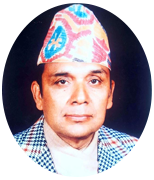
A Tribute
Professor Ashish Bose
Institute of Economic Growth,
Delhi University
I recall that I first met Dr. Yadav Prasad Pant at an international conference in New Delhi. He was in the Nepalese delegation while I was ECAFE’s (now renamed ESCAP) Resource Person. Dr. Pant made a balanced statement about his country. In the evening, we met at a reception when we were all very relaxed. Dr. Pant was sitting next to me and while talking, he was moving his hand and I noticed that he had a spectacular “fate line”on his palm. There upon, I read his palm and noticed that the lines as well as the mounts indicated ambition and power. I told him: “You will not remain long in the job you are doing because you are destined to rise very high and even become the Prime Minister of Nepal.” Dr. Pant laughed it away as a modest person. Nevertheless, he did not make fun of my palmistry. After many years, when I learnt that he became the Finance Minister of Nepal, I was not at all surprised.
After that episode in New Delhi, I met Dr.Pant whenever I went to Kathmandu to attend some conferences or take the viva voce examination of Ph.D. candidates of Tribhuvan University.Dr. Pant also made it a point to meet me whenever he came to Delhi. He was always polite, unassuming and warm-hearted.
Interestingly enough, like Dr.Man Mohan Singh who started as a Professor of Economics, then became Governor of Reserve Bank of India, then Finance Secretary, then Finance Minister and finally became Prime Minister of India, Dr.Y.P. Pant started as a Professor of Economics in Trichandra College in Kathmandu, then became Finance Secretary, then Governor of Nepal Rastra Bank, then Ambassador and finally Finance Minister. Unfortunately, he never got the chance to become Prime Minister as untimely death cut his brilliant career short. I felt very sad when I got the news about his passing away in Bangkok where he had gone for medical treatment.
In my student days, as a Ph.D. scholar at Delhi School of Economics, I was staying in Gwyer Hall,the post-graduate students’ hostel for scholars. There were several foreign students who included three students from Nepal. One of my closest friends was Bhubaneswor Prasad Daibagya, who was earlier a student of Dr.Pant. He studied law at Delhi University and later on went to Yale University in USA for further studies. After a brief spell as a judge in Nepal, he joined ESCAP as a senior officer in the International Trade Division. For over the last five decades, we have been good friends. We often discussed Nepal’s development. He was full of praise for the initiatives taken by Dr.Pant as Finance Minister.
I have lost a good friend in Dr. Pant and if he were alive, our friendship would have been further strengthened. May his soul rest in peace.
My Memories
Bernard Krisher.
Former Tokyo Bureau Chief,
Newsweek
As the Newsweek correspondent and bureau chief for many decades in Japan, I had the unique honor and pleasure of knowing and cherishing the company of Dr. Yadav Prasad Pant when he was Ambassador to Japan. I am also grateful to him for meeting and talking in-depth to my daughter, Deborah Krisher, when she visited Nepal after Dr. Pant had returned there to assume his many key positions. When Debbie visited Kathmandu with her classmates from Nishimachi International School, he briefed her and her classmates on its history and the geographic, social and economic characteristics.
Dr. Pant was not the typical diplomat in Tokyo who focused on attending receptions and exchanging small talk with his counterparts. Dr. Pant used his opportunity in Japan to deeply study its economy, and lost no opportunity to deepen relations for his country’s benefit, and always remained a very human individual. We frequently met in his office at the Nepalese Embassy which was located in a building at the corner of an intersection about five minutes from my home in Harajuku. At our meetings, he never failed to inspire me about Nepal as a great nation in Asia, and I have retained a strong desire to continue to educate myself about Nepal and think about ways of contributing to Dr. Pant’s own desire to get the wealthy, industrialized, and often selfish nations to consider the need to assist less-developed nations in their aspirations to rise economically.
Dr. Pant continued to focus on this issue after he left Japan and returned to Nepal in his multifarious activities there and around the world. In Tokyo, we frequently dined at “The Foreign Correspondents’ Club” where he met many influential journalists and also impressed them with his articulate and eloquent views on his country, the region and the world.
Dr. Pant was a distinguished scholar, diplomat and political and economic statesman who contributed enormously to Nepal’s stature in the world. I personally miss him as the eminent ambassador he was in Japan and a very warm personal friend. Although he is no longer among us, he lives in my mind and heart forever.
A Towering Personality
Eric Gonsalves
Former Indian Foreign Secretary,
Former Indian Ambassador
to Japan and European Union
Dr. Yadav Prasad Pant was a towering personality in Nepal, his own country, and in all of South Asia as well as all over the world in his field of finance and development economics. He was inducted into high office as Finance Secretary while still in his thirties. He headed the Nepal Rastra Bank (the country’s central bank) when he was barely forty. Subsequently, he held the highest office of Minister of Finance and other major ministries.
It was my privilege to have been a colleague of his in the diplomatic corps in Tokyo for the major part of his tenure there. It was then that I was able to benefit from his depth of knowledge and the breadth of his expertise in those basic issues that are of the gravest concern to all of us in South Asia, namely, how to plan, implement and speed up the process of development in our region. Japan had by then just graduated into the league of rich countries that felt obliged to become the leading donor in Asia. Japanese planners and economists had learnt the hard way from the reconstruction of the Japanese economy after the destruction suffered after the Second World War, and were eager to give us the benefit of their experiences. In the field of development, nothing can be precisely replicated. Fortunately, as we interacted with the Japanese Government, we were able to draw on the wisdom of Ambassador Pant which found receptive echoes in the attitude of academics and senior statesmen in Japan like the late Professor Saburo Okita. This made it easier to harmonise the views of Japanese and South Asian governments and business leaders to draw up more effective aid programmes at a time when our societies and economies were fairly unknown to each other.
Later, when we had both returned home, it was always a pleasure to interact with Dr. Pant on our bilateral relations and particularly on the development of regional cooperation in the South Asian region. In the early years of independence of former colonial entities, the raw nationalism can often blind leaders and officials to the advantages of cross border cooperation. It is also a matter of some regret that the generous intentions of the Government of India were sometimes translated into projects on the ground, particularly in managing common rivers which did not always provide Nepal long term benefits. It has taken the Indian establishment a long time to understand that reciprocity must be set aside in dealing with smaller neighbours. It has also taken time for the Nepalese establishment to understand that trying to play the Chinese or Western card is no sure way to put pressure on India or serve their own long term interest. Dr Pant did understand these needs and his interventions did much to sooth relations. As we turn over a new page today with a new relationship being forged between our countries, let us hope we will be able to draw on his vision.
Regional cooperation in South Asia is of primary importance to all the states of the region. Unfortunately, we have made little progress in making this a concrete engine for development and the betterment of our people. Pointing fingers and scoring points with a view to the domestic audience and media have been more evident at SAARC summits and meetings. When we had discussed regional, sub-regional cooperation or bilateral relations, I had always found Dr. Pant full of enlightened ideas and we often regretted our inability to translate them into reality. It is my hope that in the future Nepal and South Asia will make a new start along this road. That would be the finest memorial that we can give to this enlightened thinker and statesman.
A Son of Nepal
Professor Gerado P. Sicat
Former Minister of Economic Planning,
Philippines
I am happy to write about Dr. Yadav PrasadPant, a very distinguished development economist of Nepal who has written extensively on many aspects of his country’s development over many decades. He began his career as a university teacher and made a career of explaining the intricacies of Economics and the various aspects of Nepal’s economy. A man of this stature and ability could not for long remain simply in the confines of an academic shell. He would serve the international community through his work on the staff member of the Economic Commission for Asia and the Pacific (ESCAP, formerly ECAFE). In due time, he also was absorbed into his country’s officialdom in various positions of great responsibility. All these responsibilities had one central aim: the betterment of his country’s economic conditions. In his capacity as scholar and writer, his writings helped to analyze his country’s problems. As a public official, notably in various capacities in his government’s Planning Ministry and later asMinister of Finance, he applied his economic knowledge to help solve his country’s economic problems.
Dr. Pant lived a long and full life. He not only witnessed the great events of nation building in his part of the world and in Asia but also participated in some of those great events, sometimes in responsible official capacity. After his service had reached its apex, he continued to write on the economy of Nepal, helping others to understand it better.
In reviewing his life, I see a lot of parallels with mine. He began his career in the university. He later served the government in the highest capacity. He has served in international development works. And finally, he has written useful books on the economy of his country.
He lived a life of service to Nepal that deserves a celebration.
A Friend of the Filipino People
Dr. Gonzalo M. Jurado
Former Professor of Economics,
University of the Philippines
It was June 1977, when registration for the academic year was in progress at the School of Economics, University of the Philippines. One of the registrants was a young student from Nepal named Girish Pant. He was accompanied by a stately-looking self-assured gentleman who turned out to be not only his father but his country’s Ambassador to the Philippines as well.
Dr. Y. P. Pant, the Ambassador, as it turned out, was an economist of pre-eminence, very knowledgeable about the global economy. While watching his son go through the ordeal of registration, he spoke informally of similarities and differences of economic problems of some countries that came to his mind. Soon we were in animated conversation.
Of the Philippine economy he knew little, confessing that he was still trying to learn its fundamentals. He was clearly an avid student, however.
Before long, it was time for Girish to graduate with his master’s degree in Economics. I do not remember whether Dr. Pant came to witness his son’s graduation but I do recall hearing that soon after his Philippine posting, Dr. Pant returned to Nepal to accept new assignments in the fields of finance and banking as well as write learned papers.
My encounter with Dr. Pant was brief but it provided me with an opportunity to form an impression of his character. Beyond his deep academic background and extensive understanding of public issues, he was a dedicated public servant not just to the people of Nepal whom he represented with distinction, but also to the people of other countries with whom he came in contact, the people of the Philippines included.
In his passing, I feel I have lost a dear friend. There is no doubt in my mind that many other Filipinos would feel the same way, too.
My Thoughts
Late Professor Jiro Kawakita
Senior Anthropologist,
Tokyo
I still remember clearly in my mind many memories with late Dr. Yadav Prasad Pant. I have elaborated some of them below.
He had been in Japan as Ambassador from April 1974 to April 1979. During that time, I met him many times as President of Japan-Nepal Society. While he was inJapan, Their Late Majesties King Birendra and Queen Aishwarya visited the country as State Guests. I was invited to the reception and the King frankly discussed with me about his student days at Tokyo University (April-July 1967).
During his tenure in Japan, the Japan-Nepal Society invited Dr. Pant on various occasions to Hokkaido, Kyushu and Shikoku. We interexchanged a host of issues related to economics, politics and anthropology.
Dr. Pant worked actively to have dialogues with Japanese politicians, economists, businessmen, social activists and so on.
After returning to Nepal, Dr. Pant established Nepal-Japan Friendship and Cultural Association in 1979, and he was President till his demise.
When I was decorated with the Third Class Order of Trishakti-Patta from Late King Birendra in April 1987, Dr. Pant arranged a celebration party. On this occasion, I received a memorial golden frame from him which I have treasured very highly.
Dr. Pant visited Japan several times to attend conferences between 1980 and 1990. Whenever he came here, I had the privilege of meeting him and sharing opinions.
I understand that Dr. Pant was a very able Minister of Finance and Water Resources and contributed immensely for the economic advancement of his country.
Finally, I have heard that his three sons have followed their father’s footsteps working as economist, researcher and banker.
Some Recollections
Nigel Roberts
Director for the Pacific,
World Bank
When I reviewed the late Dr. Pant’s record of achievements again recently, I was both overwhelmed and humbled at what the man had achieved in one lifetime. It made me wonder what I have been doing with my own life, which has some remote parallels to his. It also made me remember the man behind the achievements, and remember him with great affection.
The first time I met Dr. Pant was in the mid-1970s, when I was a young aid worker in a medical NGO in East Nepal. I was in Kathmandu on a rare visit to the capital, and my team had been invited to a reception at the British Embassy. I remember being overwhelmed by the sophistication of the other guests-ministers, secretaries, diplomats- and finding myself very uncomfortable
in a corner, pretending to find the view of the garden interesting. At this point, a well- dressed and kindly man came and spoke to me. I missed his name, but he didn’t talk about himself anyway-he asked me who I was, how I came to be in Nepal and what I was doing. He showed great interest in my rather naive views about Nepal’s economy. Our conversation lasted over half an hour, without any appearance of waning interest on his part. As a result, the evening left me with a glow: a feeling of personal vindication for what I had been doing in parts of Kosi and Mechi, remote from the concerns of most officials I had encountered in Kathmandu. After he left, I realized I had no idea of who he was, until a few days later when reading a copy of the Rising Nepal, saw a picture of him and realized that this was the Kingdom’s Ambassador to Japan and former Governor of the Nepal Rastra Bank (and, thereby the Governor of the IMF).
I mention this at length because it said a lot about Dr. Pant. That he was easy with anyone; that he made their concerns his own; that he had no interest in putting himself into a conversation unless it added something. In more than thirty years of development work since then, much of it in so-called high circles of governance, this conversation still sits in my memory like a small jewel.
Fifteen years later, I came back to Nepal as the World Bank’s Resident Representative, and came to know Dr. Pant in a professional capacity. During my five years in the country, Yadav Prasad was at various times Minister of Water Resources, an elected member of the National Assembly and the founder member of the Rastriya Prajatantra Party. It was a turbulent, fascinating and hopeful period-in which India’s virtual blockade of Nepal’s land borders led into the People’s Movement, the 1990 Constitution and the successful national and local elections. While he was Minister of Water Resources, I worked closely with him and always enjoyed his precision, his scrupulous work habits, his modesty, his sly sense of humour and his essential consideration. I, of course, remembered him from that meeting many years before, but always assume he didn’t-until one evening at dinner in my house, when he said unexpectedly to my wife “I think Nigel looks better with short hair, don’t you?”
Later, in the post jana andalan period, when many ex-panchayat officials were scrambling for a new identity, I saw a lot of Yadav Prasad as an emergent politician. Apart from impressing me with his analytical acumen, what stays with me from that time was how unchanged his moral compass was. Without being disloyal to what he considered his essential duty to the King, Yadav Prasad had never been afraid to speak about the failings of the panchayat system and those who had corrupted it; in a similar vein, he was critical about the corruption and infighting that he saw eating at the democratic process from very early in its life. I remember one rainy night in a Kathmandu hotel in 1992 when he and I were sharing a private dinner and speaking about Nepal’s communists. I had known some of the then-leaders when I was working in Biratnagar in the ’70s, and was arguing that I thought them decent and reasonable men, not the sinister figures of the old regime’s imaginings. Indeed, I said, I thought that Nepali Congress posed more dangers to the country because it had grown arthritic in exile. I remember his answer well. “Yes” he said, “but it is worse than that, Nigel. Some lack even the constraints that the panchayati did. I am afraid that they will disappoint the people, whose hopes have been raised so high now. And this will open the door to a new era of blood-one unlike any we have seen in our recent history.” Of course he was right.
There are many other things I remember about this man. What remains most strongly with me, though, was his rather unusual combination of industriousness, modesty and kind-heartedness. Yadav Prasad was an exemplar to me, a reminder of how an official should conduct himself, and thus a reminder to me of what I should aspire to be. And, most of all in my memory, he was my friend. I mourn his passing, and add my thanks to the chorus of gratitude for a well-lived life.
Some Reflections
Dr. Ponna Wignaraja
Chairman,
South Asian Perspectives
Network Association,
Colombo
My first visit to Nepal was in 1964, when I was in the Development Advisory Service of the World Bank. My mission was to assess Nepal’s credit worthiness for funds from the World Bank’s soft loan fund, the International Development Association (IDA). IDA funding was based on two criteria – poverty and managerial capability. The first criterion posed no difficulty to establish in accordance with the Bank’s definition of poverty, at that time. The second criterion was harder to establish and I felt, in fairness to Nepal’s need for foreign capital, a great deal of care and an innovative holistic approach was required.
Dr. Yadav Prasad Pant was Finance Secretary at that time and his ministry was my point of reference. This was fortuitous as we had become friends, when he was an Economist in ESCAP, Bangkok, in the mid 1950s and I used to attend ESCAP meetings in an advisory capacity with Sri Lankan Government Delegations and Central Bank Missions. Friendship apart, for the purpose of this IDA Mission-Yadav Pant’s international experience with the World Bank and national experience as Economic Advisor to the Nepal Government and Member of the Nepal Planning Board, made him an ideal counterpart and dialogue partner. He was well informed and not only understood macro and micro issues relating to Nepal’s political economy, but he also was in his own way searching for new thinking and action suited to Nepal’s reality and culture in the context of abundant natural and human resources, which could not be addressed by conventional development thinking, locked into financial capital centric and the Cartesian approaches to development action of that time.
Dr. Bhekh Bhahadur Thapa was Member Secretary of the National Planning Commission and equally sensitive to my search for an undogmatic imaginative approach for new ways of assessing Nepal’s credit worthiness. They both understood my suggestion that I travel the length and breadth of Nepal – from Jhapa/ Ilam to Dhangadi and Jumla – to the Terai, into the Karnali Gorge, even to Edmund Hilary’s base camp in Namchebazaar, to evaluate the tourist potential. The Joint Secretary of the Panchayat Ministry at that time, Pashupati Shumsher Rana, was assigned to accompany me in this learning expedition. In the absence of roads and other rapid means of transport, the World Bank provided us with helicopters and stoll planes to travel around. It took me six months to make an in-depth assessment of the real strength and potential for pro poor growth and democratic governance in Nepal. At every turn, I would share my impressions and analysis with Yadav Pant, Bhekh Thapa and Pashupati Rana. We had long in-depth analytical sessions, which helped me refine my report to the Bank. The Bank accepted the recommendation that Nepal was IDA worthy on both criteria. An important fallout was that my main Nepalese dialogue partners also saw the development potential for Nepal in a new light. Their learning was reflected in later years, as all three of them translated the lessons we learned into innovative actions, as they moved up the political ladder into high ministerial positions and undertook complex international assignments, which included linking development with equity, security and human rights in broader terms.
To conclude, as I look back throughout the past four decades, it was the “seeds” of new development thinking that were sown in those early days by people like Yadav Pant, which resulted in strategies that rooted Nepal’s subsequent development in the people. The Back to the Village Programme and the National Development Service, the Small Farmer Development Programme of the Agricultural Development Bank of Nepal, under Shrikrishna Upadhyay, the follow-up Production Credit for Rural Women, under the guidance of Chandni Joshi, and several other such innovative national programmes that resulted in the new social movements, encompassing political democracy with economic democracy in Nepal. The Jana Andolan-I People’s Movement of 1991 and the 2006 Jana Andolan-II, which helped Nepal transform its current conflict and move the process towards sustainable democracy, with devolution of power to the people, may not otherwise have taken root. The Development with Equity process has yet to mature. A new generation of political leaders, which include the former Foreign Minister Sahana Pradan, the former Finance Minister Dr. Ram Sharan Mahat and the Maoist leadership under Prachanda, appear to understand the urgency of responding to this governance challenge.
Thank you, Dr. Yadav Prasad Pant, for helping to sow the “seeds” at a historical moment.
An Obituary
Professor Rehman Sobhan
Chairman, Center for Policy Dialogue,
Dhaka
Y. P. Pant or Y.P., as he was known to many of us, was widely known and respected throughout South Asia. first met Y.P. in Karachi around 1960, at an international conference organized by the Pakistan Institute of Development Economics. It was a major event for Pakistan with a number of distinguished economists from around the world. A number of well-known Asian economists from Hong Kong, Japan, Thailand and India also attended including Jagdish Bhagwati who was then quite young and making his name in the profession. Y.P. was then, I think, in the Planning Commission in Nepal and was the best known economist in the country where the profession was just developing. He impressed me as a sober, down to earth thinker who would serve his country well. Since then, Y.P. has indeed gone on to serve Nepal in a variety of capacities as head of the Planning Commission, Secretary, Governor of the Central Bank, Ambassador and Minister, positions he has held with distinction. In these positions, he has inspired a generation of young economists to follow his path so that Nepal is now served by a much larger number of competent economists and social scientists.
Over the years, I had occasion to encounter Y.P. either in Kathmandu or abroad at some event. In 1985, when I was President of the Bangladesh Economic Association (BEA), I invited Y.P. to the biennial conference of the BEA, where he delivered one of the keynote addresses and participated in an interesting seminar, where I had invited a number of senior policymakers who had been highly influential in economic policymaking in their respective countries. Other participants with Y.P. included Dr. Muhasher Hasan, former Finance Minister of Pakistan, Amir Jamal, former Finance Minister of Tanzania, Dr. Khusro, Member, Indian Planning Commission, Godfrey Gunatillike, former Planning Secretary, Sri Lanka and a number of well-known Bangladeshi policymakers, past and present. Y.P. joined with this distinguished galaxy of policymakers, who all knew him well, in sharing their practical experiences in making and implementing development policy. It was a memorable event in which Y.P. played an important part, drawing on his long experience with policymaking, in giving us the benefit of his wisdom.
Since then, I met Y.P. several times in Kathmandu. He remained a warm, intelligent personality with a wry sense of humour which I remember well. He earned the affection and respect of all who came to know him. The economics profession in Nepal and across South Asia will miss him. May his soul rest in peace.
Past Memories
Sataporn Jinachitra
Former President,
Export-Import Bank, Bangkok
When I was a junior economist at the Bank of Thailand, Dr Yadav Prasad Pant was already Governor of Nepal Rastra Bank. He came to the regional meeting of central bank Governors of the Southeast Asian Central Banks (SEACEN Group) in Bangkok. He was a noted character and a willing participant. To us, a Governor from a remote Himalayan Kingdom of Nepal was the most interesting person among the attending Governors. Over twenty years later, I was to meet him again when he came to the Siam Commercial Bank with a proposal to establish a new joint-venture bank in Nepal. I was then an Executive Vice President and Head of International Banking Division of the bank.
A few years after SEACEN Governors’ meeting in Bangkok, I had a chance to see Nepal for the first time when I was invited to give a lecture on “Economic Forecasting” at the SEACEN training course hosted by Nepal Rastra Bank. It was a great opportunity to learn about Nepal and the calm and peaceful way of life there. So when I led the team to study the feasibility of setting up a new bank in Nepal, it was a productive and comfortable trip, in spite of some power failure at the hotel. Though after my report that the business could be profitable, and environment was favourable, the Siam Commercial Bank was somewhat reluctant on the project since the operation was likely to be small. It was the enthusiasm and persuasiveness of Dr. Y.P.Pant that finally won over our doubts and the Bank of Kathmandu was founded.
The Siam Commercial Bank was allowed to hold only thirty percent share in the new bank. Management control was to be under the Thai bank but the Board of Directors would be mostly Nepalese representing local shareholders. Such a compromise reflected our mutual trust and the flexibility of the Thai side trusting that Dr Y.P. Pant could lead the Board. He assumed the chairmanship and
greatly helped me to steer the new bank through its challenging time in the first few years.
Looking back, after having been through a training program on “Role of the Chairman”, I realized that Dr. Y.P.Pant had performed his chairmanship effectively whether as a follower or a leader of the Board in line with the best practices. His humble, polite and diplomatic approach combined with his vast experiences in politics and human behaviour helped us get through many unusual situations. When he won his position in our business discussion, he would just smile with satisfaction without showing off that he had won. In the process of working together, I learned a lot from him about leadership development.
Dr. Y.P. Pant served in many capacities that contributed to the development of Nepal and the integration into the international community. It is not easy to find such a fine person who had worked hard and always reached out to new development in his entire life. Even when I last visited him in his hospital bed in Bangkok, he still asked me when would I visit Nepal again. He was a man who was proud of his country, who said little but had done a lot to serve people, his family, and Nepal.
I remember him and admire him for his good nature and never give-up attitude. May his journey after his fruitful life be endowed with peace and harmony, and attain the best of his wishes.
My Association
Seigo Tsujii
Lecturer, J.F. Oberlin University,
Yokohama
Dr. Pant came to Japan as Third Ambassador from April 1974 to April 1979 for five years. Though it has already been over 30 years, I still keep in mind many memories to have joined with his family and three sons, with familiar hospitality, both personally and officially.
While serving as Ambassador, he was instrumental in organizing the State Visit of Their Late Majesties King Birendra and Queen Aishwarya in June 1978. My father and I were invited to the welcome reception held at Hotel New Otani, Tokyo and the King shook hands with my father.
When I had been in Osaka officially, he visited Kansai area several times. When he visited Nara and Tenri in July 1974, his sons, Girish and Bhubanesh stayed at my house in Osaka for a week. During that period, they visited many monumental places. When Dr. Pant was invited at the reception held for the first ascent of Mt. Langtang Lirung by Osaka City University Alpine Club in October 1978, he was heartily welcomed by many senior citizens and mountaineers.
In Tokyo, often during weekends, Dr. Pant orchestrated and discussed current issues on the economy of Nepal and bilateral relations between the two countries. For example, he apprised how Five Year Economic Plans were formulated in Nepal, among other topics. These meetings have helped me to write academic papers and teach the subject of International Cooperation as a lecturer at J. F. Oberlin University since 2001 to the present.
After Dr. Pant returned to Nepal, he was appointed Minister of Finance, Commerce and Supplies and Water Resources, respectively, through which he contributed to the advancement of the nation. As President of Nepal-Japan Friendship and Cultural Association since 1979 till his demise, he contributed to the development of bilateral relations between the two countries. When the Educational Mission of Kyoto Bunkyo Gauken (then Kyoto Kasei Gauken) visited Kathmandu to discuss the sisterly relations with Padma Kanya Multiple Campus in December 1980, he met the Mission at the Minister’s office. He also spent one hour with me discussing various educational issues.
When Dr. Pant visited Tokyo with Madam in October 1988 at the invitation of Japan-Nepal Society, he interacted on economic issues with various members. In April 1990, they revisited Japan.
Beginning from 1992 to the present, I have visited Kathmandu every year for a week or so. I always found time to meet Dr. Pant at his residence and interact on various issues. Finally, I thank all his family members as they always remind me of beautiful memories both in Tokyo and Kathmandu.
Living Memories
Dr. Yasuko Wachi
Professor, Josai International
University, Japan
Ichiro Wachi,
Chairman and President of the
Board of Directors,
Tokyo International Language Center
When Dr. Girish P. Pant wrote to us about the untimely demise of his beloved father, the late Dr. Yadav Prasad Pant, we were very shocked and felt deeply saddened. Somehow, we always had thought that a wonderful person like him with so many great achievements will never die. In fact, he will be in our hearts with wonderful living memories that we cherish for years to come.
It was in 1974 that Dr. Yadav Prasad Pant came to Japan to live in Tokyo as the Royal Nepalese Ambassador, and that was the first time for us to have the honor and pleasure of meeting him, always together with gracious Mrs. Rama Pant.
My husband and I with our two children (still very young at that time for our daughter was born in 1968 and our son born only in 1972) were warmly welcomed to their home, not only in Tokyo, but later also in Kathmandu, where they welcomed all of us with full generosity as if we were members of their family. In Tokyo, Dr. Girish P. Pant was still a student at Sophia University at Ichigaya, Tokyo, so we had many opportunities to see him. But in Kathmandu, we were fortunate to meet all of his four children, Mira, Girish, Bhubanesh, and Radhesh, later with their wonderful spouses. In fact, Dr. Yadav Prasad Pant and Mrs. Rama Pant built and offered a very happy family life for everyone who came to their home both in Tokyo and in Kathmandu. They welcomed us and our friends with open hearts and true hospitality that we could all feel very safe and at home under their roof.
With our young children, Dr. Pant often spoke in Japanese which he learned while living in Tokyo. It was a true expression of his affectionate and humble personality when we hear him say to our children, something like “Tomoko-san, Shinichiro-san, Daijobu?” which in Japanese means “Are you alright? Are you comfortable? Are you enjoying Nepalese food? Are you happy in Nepal?” We still can hear his voice in our hearts, and that makes us miss him so much and long for his loving person caring for all. Now our children are grown up: Tomoko Sagun is a space designer and is married to Mr. Alan Edwards, and Shinichiro Pratap holds a Ph.D. degree in bioinformatics working as a post-doctoral researcher and is married to a wonderful scientist Fei Huang, also a Ph.D. degree holder in pharmaceutical sciences; and they are all living in the United States. When we get together, we still remember what a wonderful father-like person the late Dr. Y.P. Pant was to all of us, always caring for each one’s wellness and happy life in his home.
He and his wife, Mrs Rama Pant, were great sponsors supporting many NGO organizations for women and children both in Japan and in Nepal. One of them which we visited in Nepal was TEWA. Mrs. Meera Arjyal was one of the founders and leaders in that organization. We saw active Nepalese women leaders reaching out to the urban and rural communities with sizable and practical development projects in order to alleviate poverty with the self-supporting efforts of many local communities. The late Dr. Yadav Prasad Pant was a real supporter of these women and children, and TEWA, for me, was an inspiration in rethinking the community development and the power of women leadership as I now teach women in development in the gender and women’s studies programs at Josai International University in Japan.
He was an excellent teacher, who taught almost all the scholars and dignitaries we met in Nepal. As a banker, economist, as well as statesman, he will be remembered by the great nation of Nepal. What a loss to Nepal, yet we realize now that he has left so much, so rich, and firm foundations for Nepal’s nation building not only in Nepal but also in Japan, Thailand, Philippines, Korea, Australia, New Zealand and beyond. He was loved and appreciated everywhere he went, because his kindness and generosity was genuine and extended to the greatest dignitaries and even to the small children.
Our hearts ache as we mourn the demise of the late Dr. Yadav Prasad Pant. But our memories are vivid and living in our hearts as they will live in the hearts of all of us, including our dear friends in Nepal. We hear his loving voice, “Daijobu? Are you happy?” Then we would answer him, “Yes, we are happy to have known you. Thank you, Dr. Pant! May your soul and spirit rest in peace!”